
What Is A Modulus Of A Number? Complete Guide with Examples
Get personalized tutoring support today.
Call Now: +1-514-588-7682Quick Answer: What Is a Modulus of a Number?
The modulus of a number is the remainder left over after dividing it by another number. Written as a mod n, it always gives a result between 0 and n−1. For example, 17 mod 5 = 2, because 17 ÷ 5 leaves a remainder of 2. In programming, the modulus operator is the percent sign (%), and it is used constantly for tasks like checking even/odd numbers, wrapping array indexes, and clock arithmetic.
Quick Summary: Modulus of a Number
- Modulus finds the remainder after division (e.g., 17 mod 5 = 2)
- Formula: a mod n = remainder when dividing a by n
- Symbol: % in programming, « mod » in math
- Applications: Even/odd checks, clock arithmetic, cryptography, programming
- Range: Result is always between 0 and (n-1)
The modulus (also called the modulo operation or remainder operation) is a mathematical operation that finds the remainder after dividing one number by another. It’s one of the most useful operations in mathematics, computer science, and everyday problem-solving—essential for students in Montreal learning programming, cryptography, or advanced math.
In simple terms: modulus gives you what’s left over after division.
What Is a Modulus of a Number?
💡 Quick Example
17 mod 5 = ?
17 ÷ 5 = 3 with a remainder of 2
Therefore: 17 mod 5 = 2
When you divide one number by another, you often get a quotient (the whole number result) and a remainder (what’s left over). The modulus operation gives you that remainder.
How Does the Modulus Operation Actually Work?
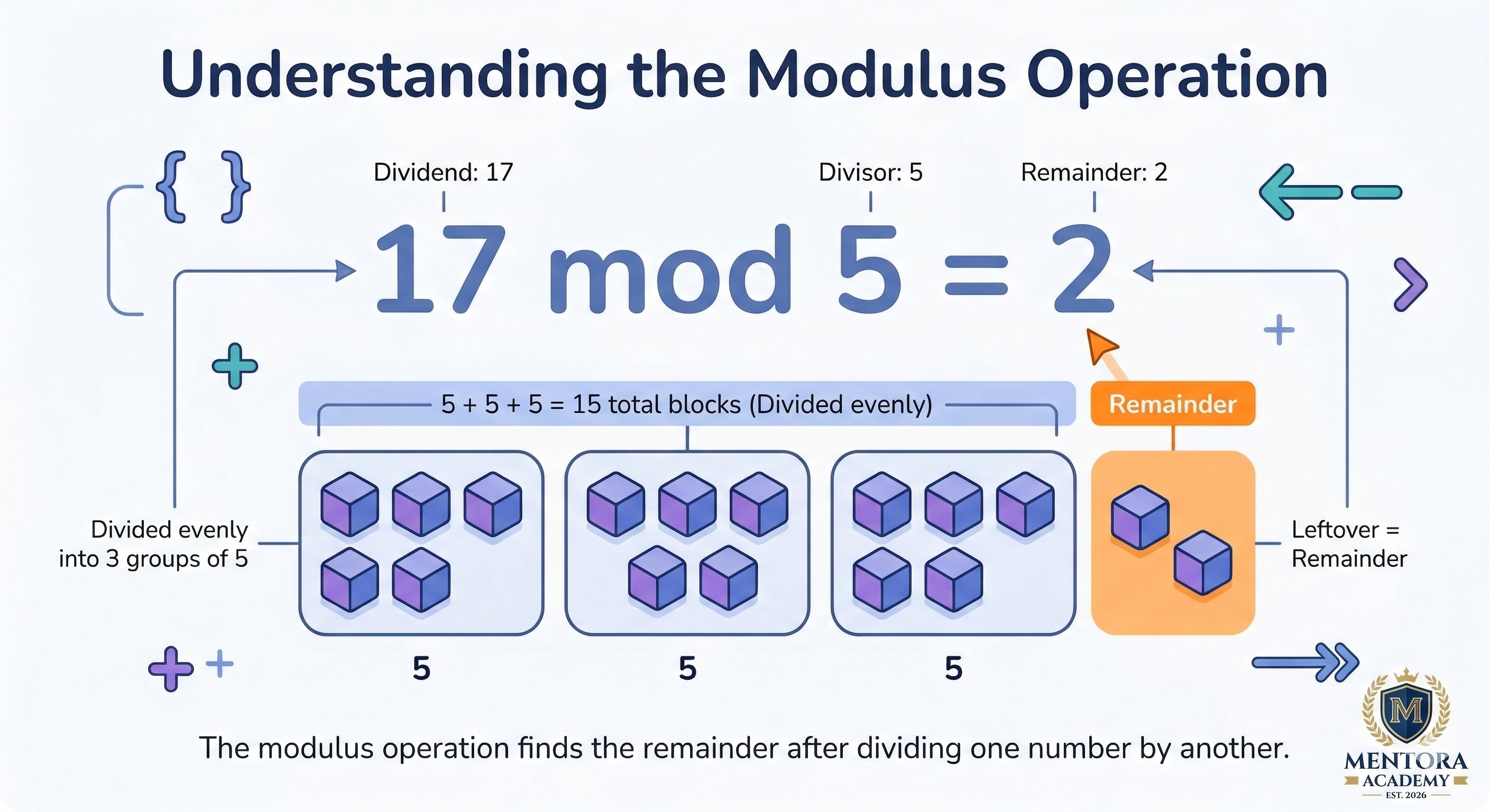
The Basic Concept
Division Breakdown Example
Let’s divide 17 by 5:
- 17 ÷ 5 = 3 remainder 2
- This means: 17 = (5 × 3) + 2
- The quotient is 3
- The remainder is 2
- Therefore: 17 mod 5 = 2
⚠️ Key Distinction: Modulus vs. Division
There is a small but very important distinction to keep in mind:
When you divide 17 by 5:
- The Quotient (result of division) is 3 → This tells you how many full groups of 5 you can make
- The Modulus (result of mod operation) is 2 → This tells you only what is left over after making those groups
Visual Example: 17 Items in Groups of 5
●●●●● ●●●●● ●●●●● + ●●
Group 1 Group 2 Group 3 Remaining
- Group 1: 5 blocks
- Group 2: 5 blocks
- Group 3: 5 blocks
- Remaining: 2 blocks (this is the modulus!)
How to Answer Different Questions
If someone asks « What is 17 ÷ 5? », the answer is: 3 remainder 2
But if someone asks « What is 17 mod 5? », they only want the remainder: 2
Summary Table
| Operation | Question Being Asked | Result for 17 and 5 |
|---|---|---|
| Division (17 ÷ 5) | How many groups of 5 are there? | 3 (Quotient) |
| Modulus (17 mod 5) | What is left over after the groups are made? | 2 (Remainder) |
Mathematical Notation
Modulus Formula
a mod n = r
Where:
- a = dividend (number being divided)
- n = divisor (number dividing by)
- r = remainder (result of modulus operation)
Important: The remainder r must always satisfy: 0 ≤ r < n
Need help understanding modulus for your programming or math class?
📞 Book a free evaluation: (514) 588-7682
How Do You Calculate Modulus Step by Step?
Example 1: 10 mod 3
- Divide: 10 ÷ 3 = 3 remainder 1
- Verify: 3 × 3 = 9, and 10 – 9 = 1
- Result: 10 mod 3 = 1
Example 2: 25 mod 7
- Divide: 25 ÷ 7 = 3 remainder 4
- Verify: 7 × 3 = 21, and 25 – 21 = 4
- Result: 25 mod 7 = 4
Example 3: 20 mod 5
- Divide: 20 ÷ 5 = 4 remainder 0
- Verify: 5 × 4 = 20, and 20 – 20 = 0
- Result: 20 mod 5 = 0
- Note: When remainder is 0, the dividend is evenly divisible by the divisor
Example 4: 7 mod 10
- Divide: 7 ÷ 10 = 0 remainder 7
- Verify: 10 × 0 = 0, and 7 – 0 = 7
- Result: 7 mod 10 = 7
- Note: When dividend < divisor, the modulus equals the dividend
What Are the Key Properties of the Modulus Operation?
Key Properties to Remember
1. Range of Results
For a mod n, the result is always: 0 ≤ r < n
Example: Any number mod 5 will give: 0, 1, 2, 3, or 4
2. Distributive Property (Addition)
(a + b) mod n = [(a mod n) + (b mod n)] mod n
Example:
(13 + 17) mod 5 = [(13 mod 5) + (17 mod 5)] mod 5
30 mod 5 = [3 + 2] mod 5 = 5 mod 5 = 0
3. Distributive Property (Multiplication)
(a × b) mod n = [(a mod n) × (b mod n)] mod n
Example:
(8 × 6) mod 5 = [(8 mod 5) × (6 mod 5)] mod 5
48 mod 5 = [3 × 1] mod 5 = 3
4. Zero Modulus Special Case
a mod n = 0 means a is evenly divisible by n
Example: 15 mod 5 = 0 (because 15 = 5 × 3, no remainder)
5. Identity Property
If a < n, then a mod n = a
Example: 3 mod 10 = 3 (because 3 is smaller than 10)
Struggling with modular arithmetic in computer science or math?
📞 Get expert help: (514) 588-7682
Where Is Modulus Used in Real Life?
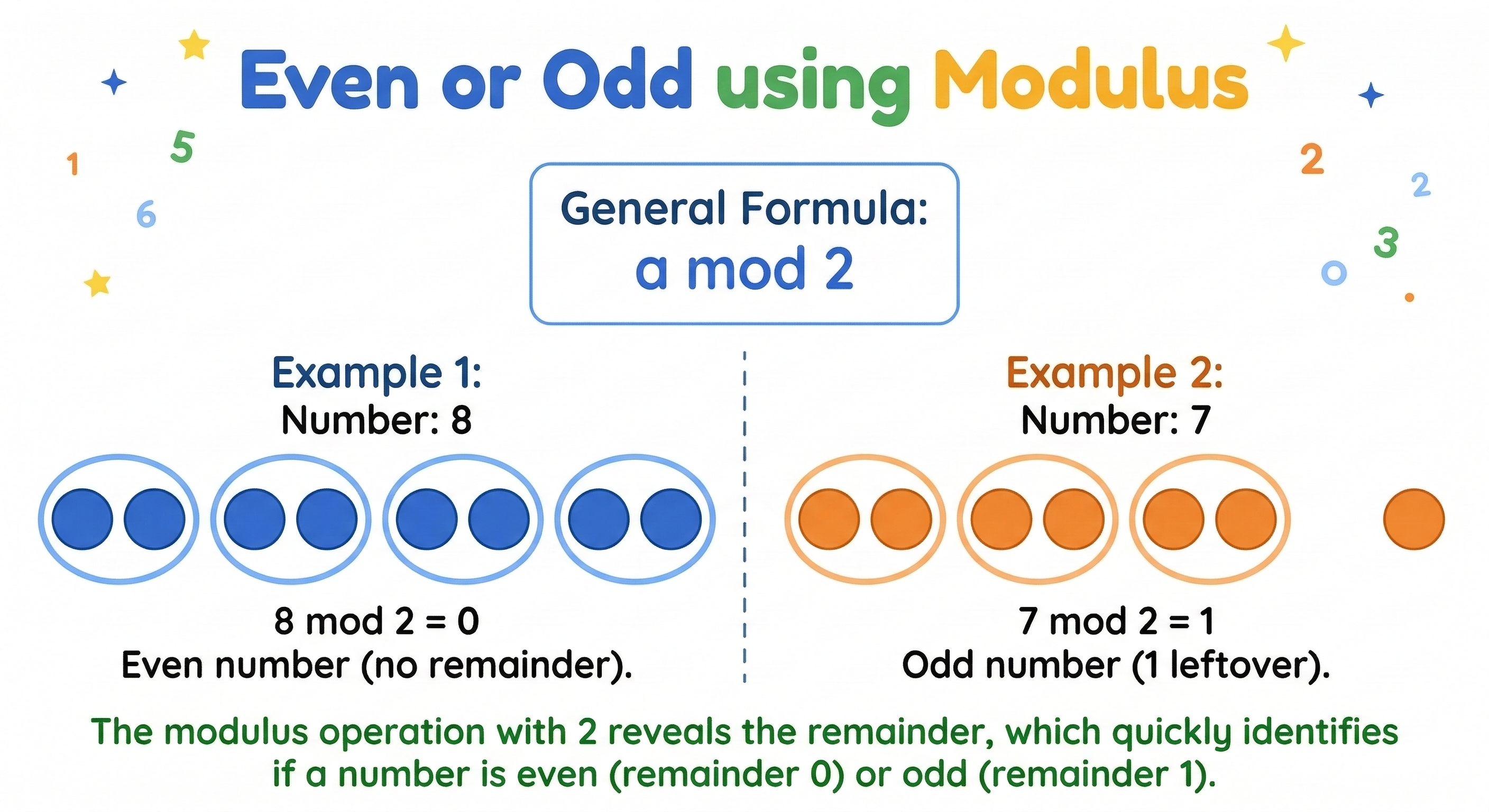
1. Determining Even or Odd Numbers
The most common use of modulus: checking if a number is even or odd. This is directly related to understanding whether zero is even or odd, which uses the modulus concept.
- Even numbers: number mod 2 = 0
- Odd numbers: number mod 2 = 1
Examples:
- 10 mod 2 = 0 → 10 is even
- 15 mod 2 = 1 → 15 is odd
- 144 mod 2 = 0 → 144 is even
2. Clock Arithmetic (12-Hour System)
Modulus is perfect for circular/repeating systems like clocks!
Problem: What time is it 25 hours from now if it’s currently 10:00?
Solution:
- Current time: 10:00
- Add 25 hours: 10 + 25 = 35
- Apply mod 12: 35 mod 12 = 11
- Answer: 11:00
3. Array Indexing and Circular Buffers
In programming, modulus creates circular patterns in arrays
// Access array elements in a circular manner

index = (currentIndex + 1) % arrayLength// Example: Array with 5 elements

// When at index 4, next is (4+1) % 5 = 0 (wraps to start)
4. Hashing and Data Distribution
Hash tables use modulus to distribute data across buckets:
bucketNumber = hashValue % numberOfBucketsThis ensures even distribution across available storage locations
5. Cryptography and Security
Modular arithmetic is fundamental to modern encryption algorithms like RSA
- Used in public-key cryptography
- Essential for encoding and decoding messages
- Provides mathematical security guarantees
- Enables secure online transactions
6. Checking Divisibility
Quickly determine if a number is divisible by another:
- n mod d = 0 means n IS divisible by d
- n mod d ≠ 0 means n is NOT divisible by d
Example: Is 144 divisible by 12?
144 mod 12 = 0 → Yes, 144 is evenly divisible by 12
Related Mathematical Concepts
Understanding modulus helps with other important math topics:
- What Is An Integer? – Learn about whole numbers and division
- What Is the Slope? – Understanding rate of change in mathematics
How Is Modulus Used in Programming Languages?
Syntax in Different Languages
Python
result = 17 % 5  # Returns 2

print(17 % 5)    # Output: 2# Check if number is even

if num % 2 == 0:

    print("Even")
JavaScript
let result = 17 % 5;  // Returns 2

console.log(17 % 5);  // Output: 2// Check if number is odd

if (num % 2 === 1) {

    console.log("Odd");

}
Java
int result = 17 % 5;  // Returns 2

System.out.println(17 % 5);  // Output: 2// Check divisibility

if (num % 3 == 0) {

    System.out.println("Divisible by 3");

}
C/C++
int result = 17 % 5;  // Returns 2

printf("%d", 17 % 5);  // Output: 2
Need programming help with modulus operations?
📞 Book a session: (514) 588-7682
📝 Practice Problems
Easy Level (Problems 1-5)
1. Calculate: 14 mod 3
2. Calculate: 20 mod 6
3. Is 24 even or odd? (Use modulus)
4. Calculate: 100 mod 10
5. Calculate: 5 mod 8
Medium Level (Problems 6-10)
6. What time is it 30 hours after 8:00? (Use mod 12)
7. Is 157 divisible by 5? (Use modulus)
8. Calculate: 99 mod 7
9. Find all possible results of: n mod 4
10. If today is Wednesday (day 3), what day is it 20 days from now? (Use mod 7)
Challenge Level (Problems 11-15)
11. Calculate: (15 + 23) mod 8
12. Calculate: (6 × 7) mod 5
13. What is the last digit of 7^100? (Hint: Use modulus)
14. In an array of length 10, if current index is 8 and we move forward 5 positions, what’s the new index?
15. Is 2,468 divisible by both 2 and 4?
Complete Solutions
Easy Level Solutions
1. 14 mod 3 = 2 (14 ÷ 3 = 4 remainder 2)
2. 20 mod 6 = 2 (20 ÷ 6 = 3 remainder 2)
3. 24 mod 2 = 0, so 24 is even
4. 100 mod 10 = 0
5. 5 mod 8 = 5 (dividend < divisor)
Medium Level Solutions
6. (8 + 30) mod 12 = 38 mod 12 = 2 → 2:00
7. 157 mod 5 = 2 (not 0), so not divisible by 5
8. 99 mod 7 = 1 (99 ÷ 7 = 14 remainder 1)
9. Possible results: 0, 1, 2, 3
10. (3 + 20) mod 7 = 23 mod 7 = 2 → Tuesday (day 2)
Challenge Level Solutions
11. (15 + 23) mod 8 = 38 mod 8 = 6
12. (6 × 7) mod 5 = 42 mod 5 = 2
13. Look for pattern: 7^1=7, 7^2=49 (last digit 9), 7^3=343 (last digit 3), 7^4=2401 (last digit 1). Pattern repeats every 4. 100÷4=25, so last digit is 1
14. (8 + 5) mod 10 = 13 mod 10 = 3
15. 2468 mod 2 = 0 (even), 2468 mod 4 = 0. Yes, divisible by both
❓ Frequently Asked Questions
Q1: What is modulus in math?
A: Modulus is a mathematical operation that finds the remainder after dividing one number by another. For example, 17 mod 5 = 2 because 17 ÷ 5 = 3 with remainder 2.
Q2: How do you calculate modulus?
A: To calculate a mod n: divide a by n, then take the remainder. For example, 25 mod 7: divide 25 by 7 to get 3 remainder 4, so 25 mod 7 = 4.
Q3: What is the modulus symbol?
A: In programming, modulus is represented by the percent symbol (%). In mathematics, it is written as "mod", for example: 17 mod 5.
Q4: What is modulus used for?
A: Modulus is used for checking even/odd numbers, clock arithmetic, array indexing, cryptography, hash functions, and determining divisibility.
Q5: Can modulus be negative?
A: In most programming languages, modulus with negative numbers is handled differently. In mathematics, the result is typically defined to be non-negative (0 ≤ r < n).
Q6: What does 0 mod n equal?
A: 0 mod n always equals 0 for any positive n, because 0 divided by any number gives quotient 0 and remainder 0.
Q7: Is modulus the same as remainder?
A: Yes! Modulus and remainder mean the same thing. Both refer to what is left over after division.
Q8: What is the difference between division and modulus?
A: Division gives you the quotient (how many times the divisor goes into the dividend), while modulus gives you the remainder (what is left over).
🎯 Need Help Mastering Modulus?
Get expert tutoring in math, programming, or computer science
Join 2,500+ Montreal students who improved their grades
✓ Free evaluation session
✓ Certified expert tutors
✓ Proven results in weeks
Available 7 days/week • Same-day appointments
Conclusion
Congratulations! You now understand what modulus is, how to calculate it, and its practical applications in mathematics, programming, and everyday problem-solving. Whether you're checking if numbers are even or odd, working with circular data structures, or building secure encryption algorithms, modulus is an essential tool in your mathematical toolkit.
Continue Your Math Learning Journey
Now that you understand modulus, explore these related topics:
- Unit Conversions Guide - Master converting between different units
- Measurement Units Explained - Understanding SI units and more
Key takeaways:
- ✅ Modulus finds the remainder after division
- ✅ Formula: a mod n = remainder when dividing a by n
- ✅ Result is always between 0 and (n-1)
- ✅ Essential for programming, cryptography, and number theory
- ✅ Used in real-world applications like clock arithmetic and hash tables
Keep practicing with the problems above, and soon modulus operations will become second nature. If you need personalized help with modulus, programming, or any math topic, our Montreal tutors are here to support your learning journey!