
What Is a Parabola? Definition, Equation & Real-World Applications
Get personalized tutoring support today.
Call Now: +1-514-588-7682
Quick Summary: What Is a Parabola?
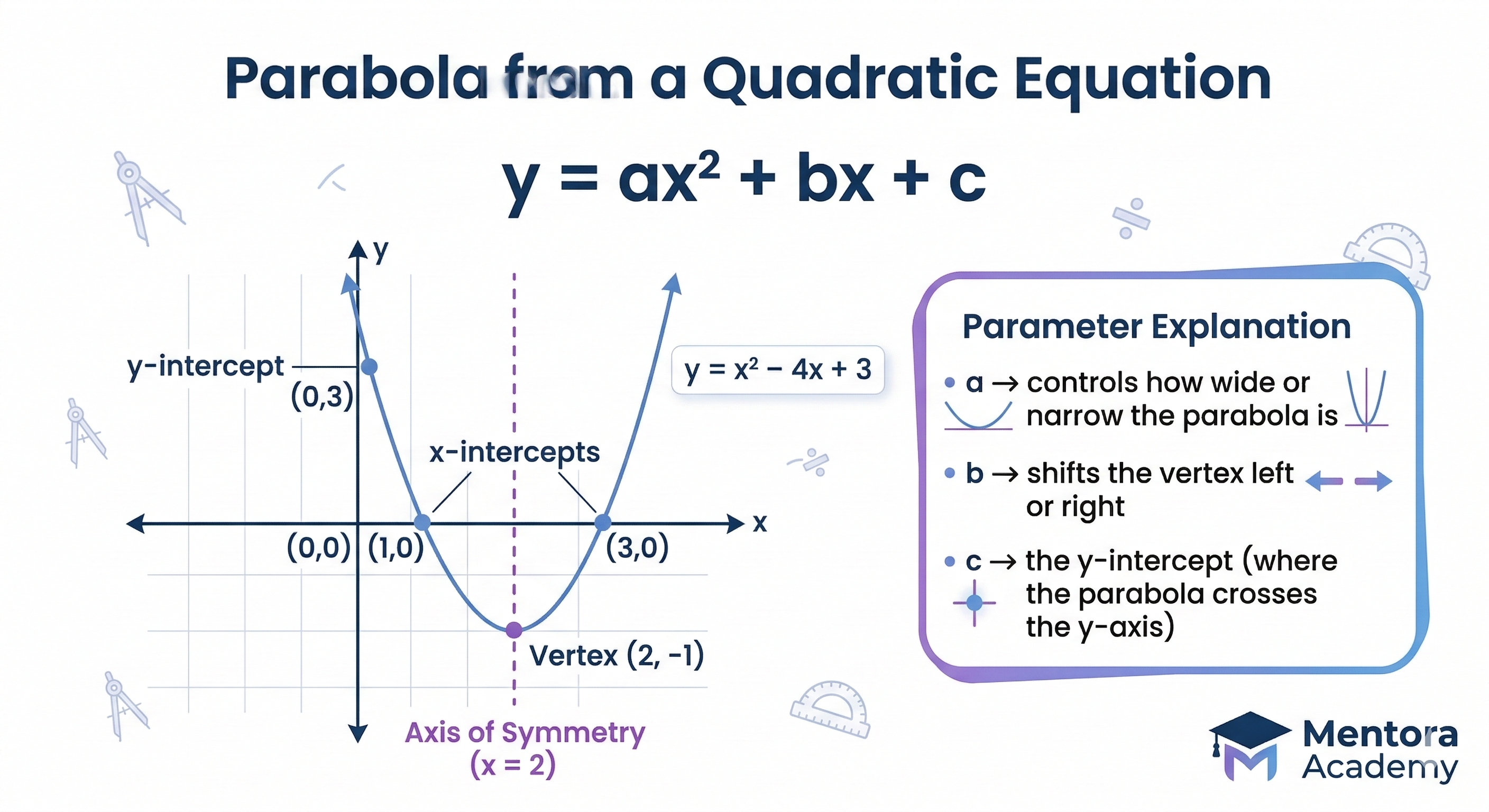
- Definition: A parabola is a U-shaped curve representing a quadratic function (y = ax² + bx + c)
- Key Parts: Vertex (highest/lowest point), axis of symmetry (vertical line through vertex), and opening direction
- Vertex Form: y = a(x – h)² + k, where (h, k) is the vertex
- Opening Direction: If a > 0, parabola opens upward; if a < 0, it opens downward
- Real Applications: Bridges, satellite dishes, fountains, projectile motion, and Montreal architecture
📖 Read time: 15 minutes
What Is a Parabola?
A parabola is one of the most beautiful and useful curves in mathematics. Whether you’re launching a basketball toward a hoop at Montreal’s Olympic Stadium, designing the arch of Jacques-Cartier Bridge, or aiming a satellite dish to receive signals, you’re working with parabolas.
In mathematics, a parabola is the U-shaped curve you get when you graph a quadratic function. Every parabola has a special point called the vertex (the tip of the U), an invisible vertical line called the axis of symmetry that divides it perfectly in half, and a direction it opens (either upward ☝️ or downward 👇).
Students in Montreal’s Secondary 3, 4, and 5 classes study parabolas as part of algebra and functions. Understanding parabolas isn’t just about passing tests—it’s about seeing how mathematics describes the world around you, from the trajectory of a soccer ball at Parc Jarry to the design of Place Ville Marie’s architecture.
In this comprehensive guide, you’ll learn what a parabola is, master the quadratic equation and vertex form, discover how to graph parabolas step-by-step, work through 15+ practice problems with solutions, and explore real-world applications throughout Montreal and beyond.
How Is a Parabola Defined Mathematically?
Mathematically, a parabola is defined in two equivalent ways:
Geometric Definition
A parabola is the set of all points in a plane that are equidistant from a fixed point (called the focus) and a fixed line (called the directrix). While this definition is beautiful, most Secondary students work with the algebraic definition instead.
Algebraic Definition (What You’ll Use Most)
A parabola is the graph of a quadratic function, which has the general form:
y = ax² + bx + c
Where:
- a, b, c are constants (numbers)
- a ≠ 0 (if a = 0, it’s just a straight line, not a parabola)
- x is the independent variable
- y is the dependent variable
The value of a is crucial because it determines:
- The direction the parabola opens (up or down)
- How wide or narrow the parabola is
What Is the Difference Between Standard Form and Vertex Form?
Quadratic functions (and their parabolas) can be written in two main forms, each useful for different purposes.
Standard Form
y = ax² + bx + c
Best for: Quickly identifying the y-intercept (the value of c) and using the quadratic formula
Example: y = 2x² + 4x – 3
- a = 2 (opens upward, somewhat narrow)
- b = 4
- c = -3 (y-intercept is -3)
Vertex Form
y = a(x – h)² + k
Best for: Immediately identifying the vertex and graphing the parabola
Where (h, k) is the vertex of the parabola
Example: y = 2(x – 3)² + 5
- a = 2 (opens upward)
- Vertex is at (3, 5)
- Axis of symmetry is x = 3
💡 Pro Tip: In Montreal’s Secondary 4 and 5 classes, you’ll need to convert between these forms. Vertex form is often easier for graphing, while standard form is better for finding x-intercepts (roots).
What Are the Key Parts of a Parabola?
Every parabola has several important features you need to identify:
1. The Vertex
The vertex is the highest or lowest point on the parabola—the « tip » of the U-shape.
- If the parabola opens upward (a > 0), the vertex is the minimum point
- If the parabola opens downward (a < 0), the vertex is the maximum point
How to find the vertex from standard form:
The x-coordinate of the vertex is: x = -b / (2a)
Then substitute this x-value back into the equation to find the y-coordinate.
2. Axis of Symmetry
The axis of symmetry is an imaginary vertical line that passes through the vertex and divides the parabola into two mirror-image halves.
The equation of the axis of symmetry is: x = h (where h is the x-coordinate of the vertex)
3. Y-Intercept
The y-intercept is where the parabola crosses the y-axis. This always occurs when x = 0.
In standard form (y = ax² + bx + c), the y-intercept is simply c.
4. X-Intercepts (Roots or Zeros)
The x-intercepts are the points where the parabola crosses the x-axis (where y = 0). A parabola can have:
- Two x-intercepts (crosses the x-axis twice)
- One x-intercept (touches the x-axis at the vertex)
- No x-intercepts (doesn’t touch the x-axis at all)
5. Opening Direction
The opening direction tells you which way the parabola « opens »:
- If a > 0 (positive), the parabola opens upward ☝️ (like a smile 😊)
- If a < 0 (negative), the parabola opens downward 👇 (like a frown 🙁)
How Do You Graph a Parabola Step by Step?
Graphing a parabola becomes easy when you follow these systematic steps.
Method 1: From Vertex Form
Example: Graph y = 2(x – 1)² – 3
Step 1: Identify the vertex
Vertex form is y = a(x – h)² + k
Here: h = 1, k = -3
Vertex: (1, -3)
Step 2: Determine opening direction
a = 2 (positive)
Opens upward ☝️
Step 3: Plot the vertex on a graph
Step 4: Find additional points by choosing x-values
Try x = 0: y = 2(0-1)² – 3 = 2(1) – 3 = -1
Point: (0, -1)
Try x = 2: y = 2(2-1)² – 3 = 2(1) – 3 = -1
Point: (2, -1)
Step 5: Draw a smooth U-shaped curve through the points
Method 2: From Standard Form
Example: Graph y = x² + 4x + 3
Step 1: Find the vertex
x-coordinate: x = -b/(2a) = -4/(2×1) = -4/2 = -2
y-coordinate: y = (-2)² + 4(-2) + 3 = 4 – 8 + 3 = -1
Vertex: (-2, -1)
Step 2: Determine opening direction
a = 1 (positive)
Opens upward ☝️
Step 3: Find the y-intercept
y-intercept is c = 3
Point: (0, 3)
Step 4: Find x-intercepts (optional)
Factor: y = (x + 1)(x + 3)
x-intercepts: x = -1 and x = -3
Points: (-1, 0) and (-3, 0)
Step 5: Draw the parabola through all points
Need help understanding parabolas and quadratic functions?
📞 Book a free evaluation: (514) 588-7682
15+ Practice Problems with Solutions
Master parabolas by working through these problems! Click « Show Solution » to check your work.
Easy Problems (Secondary 3 Level)
Problem 1: Identify the vertex and opening direction of y = (x – 2)² + 5
Solution:
This is in vertex form: y = a(x – h)² + k
h = 2, k = 5, a = 1 (positive)
Vertex: (2, 5)
Opens: Upward ☝️ (since a > 0)
Problem 2: What is the y-intercept of y = x² – 3x + 7?
Solution:
In standard form y = ax² + bx + c, the y-intercept is c
Y-intercept: 7
Point: (0, 7)
Problem 3: Does y = -2x² + 4x – 1 open upward or downward?
Solution:
Check the value of a
a = -2 (negative)
Opens: Downward 👇 (since a < 0)
Medium Problems (Secondary 4 Level)
Problem 4: Find the vertex of y = x² + 6x + 5
Solution:
Use formula: x = -b/(2a)
x = -6/(2×1) = -6/2 = -3
Substitute x = -3: y = (-3)² + 6(-3) + 5 = 9 – 18 + 5 = -4
Vertex: (-3, -4)
Problem 5: Convert y = (x + 4)² – 9 to standard form
Solution:
Expand the square:
y = (x + 4)(x + 4) – 9
y = x² + 4x + 4x + 16 – 9
y = x² + 8x + 7
Standard form: y = x² + 8x + 7
Problem 6: Find the axis of symmetry for y = 2x² – 8x + 3
Solution:
The axis of symmetry is x = -b/(2a)
x = -(-8)/(2×2) = 8/4 = 2
Axis of symmetry: x = 2
Problem 7: Convert y = x² – 4x + 1 to vertex form
Solution:
Complete the square:
y = x² – 4x + 1
y = (x² – 4x + 4) + 1 – 4
y = (x – 2)² – 3
Vertex form: y = (x – 2)² – 3
Vertex: (2, -3)
Struggling with converting between forms or graphing parabolas?
📞 Get expert help: (514) 588-7682
Challenging Problems (Secondary 5 Level)
Problem 8: A parabola has vertex (3, -5) and passes through point (5, 3). Find its equation in vertex form.
Solution:
Start with vertex form: y = a(x – 3)² – 5
Substitute point (5, 3):
3 = a(5 – 3)² – 5
3 = a(2)² – 5
3 = 4a – 5
8 = 4a
a = 2
Equation: y = 2(x – 3)² – 5
Problem 9: Find the x-intercepts of y = x² + 2x – 8
Solution:
Set y = 0 and factor:
0 = x² + 2x – 8
0 = (x + 4)(x – 2)
x = -4 or x = 2
X-intercepts: (-4, 0) and (2, 0)
Problem 10: A ball is thrown upward with equation h(t) = -5t² + 20t + 2, where h is height in meters and t is time in seconds. When does the ball reach maximum height?
Solution:
Maximum height occurs at the vertex
t = -b/(2a) = -20/(2×(-5)) = -20/(-10) = 2
Maximum height at t = 2 seconds
Height: h(2) = -5(2)² + 20(2) + 2 = -20 + 40 + 2 = 22 meters
Problem 11: Write the equation of a parabola with vertex (-1, 4) that opens downward and has width similar to y = -3x²
Solution:
Vertex form: y = a(x – h)² + k
Vertex: (-1, 4), so h = -1, k = 4
Opens downward with same width as y = -3x², so a = -3
Equation: y = -3(x + 1)² + 4
Problem 12: Find the range of y = -(x – 3)² + 7
Solution:
Vertex: (3, 7)
a = -1 (negative), so opens downward
Maximum value is y = 7 at the vertex
Range: y ≤ 7 or (-∞, 7]
Problem 13: The path of a rocket is modeled by h(t) = -4.9t² + 49t + 5. What is the maximum height?
Solution:
Find vertex: t = -b/(2a) = -49/(2×(-4.9)) = -49/(-9.8) = 5
Maximum height: h(5) = -4.9(5)² + 49(5) + 5
h(5) = -4.9(25) + 245 + 5 = -122.5 + 245 + 5 = 127.5 meters
Maximum height: 127.5 meters at t = 5 seconds
Problem 14: For what values of x is y = x² – 6x + 8 equal to zero?
Solution:
Factor: y = (x – 2)(x – 4)
Set y = 0: (x – 2)(x – 4) = 0
x = 2 or x = 4
Problem 15: A fountain’s water stream follows y = -0.5x² + 4x, where x and y are in meters. What is the maximum height of the water?
Solution:
Find vertex: x = -b/(2a) = -4/(2×(-0.5)) = -4/(-1) = 4
Maximum height: y = -0.5(4)² + 4(4) = -0.5(16) + 16 = -8 + 16 = 8
Maximum height: 8 meters
Problem 16: Write y = 3x² – 12x + 7 in vertex form and identify the vertex.
Solution:
Complete the square:
y = 3(x² – 4x) + 7
y = 3(x² – 4x + 4 – 4) + 7
y = 3(x² – 4x + 4) – 12 + 7
y = 3(x – 2)² – 5
Vertex form: y = 3(x – 2)² – 5
Vertex: (2, -5)
Where Do Parabolas Show Up in Montreal and Beyond?
Parabolas aren’t just abstract mathematical concepts—they appear everywhere in the real world, especially throughout Montreal.
1. Architecture and Bridge Design
Montreal’s iconic Jacques-Cartier Bridge uses parabolic arches in its design. The graceful curves you see aren’t just beautiful—they’re parabolic shapes that distribute weight efficiently, making the bridge both strong and elegant. The Gateway Arch in St. Louis uses a similar parabolic design, though it’s actually a weighted catenary curve that closely resembles a parabola.
In Old Montreal, many historical buildings feature parabolic arches in doorways and windows. These arches can support more weight than simple rectangular openings while creating visually striking architecture.
2. Satellite Dishes and Radio Telescopes
Walk around Montreal and you’ll see satellite dishes on buildings throughout the city. These dishes are shaped like parabolas because of a special property: all signals that hit the parabolic surface reflect to a single point called the focus. This is why satellite dishes can capture weak signals from space—the parabolic shape concentrates all the signal at one receiver point.
The same principle works in reverse for broadcasting: placing a transmitter at the focus of a parabolic reflector creates a focused beam of radio waves or light.
3. Sports and Projectile Motion
Every time the Montreal Canadiens shoot a puck, a baseball player at Olympic Stadium hits a home run, or a basketball player at Centre Bell makes a shot, the projectile follows a parabolic path (ignoring air resistance).
The equation for projectile motion is quadratic: h(t) = -½gt² + v₀t + h₀, where:
- g is gravitational acceleration (9.8 m/s² on Earth)
- v₀ is initial velocity
- h₀ is initial height
Athletes and coaches study these parabolic trajectories to optimize their performance.
4. Water Fountains and Waterfalls
The beautiful fountains at Place Ville-Marie and Parc La Fontaine create parabolic arcs as water shoots through the air. The water follows the same parabolic path as any projectile, creating those graceful curves you see.
Engineers designing these fountains use quadratic equations to calculate the water pressure needed to achieve desired heights and distances.
5. Car Headlights and Flashlights
The reflectors inside car headlights (like those on cars driving through Montreal’s streets) and flashlights are shaped like parabolas. Just like satellite dishes work in reverse, placing a light bulb at the focus of a parabolic reflector creates a strong, focused beam of light pointing straight ahead.
This is why high-quality flashlights have parabolic reflectors—they concentrate the light into a powerful beam rather than letting it scatter in all directions.
What Mistakes Do Students Make With Parabolas?
Even strong math students make these errors with parabolas. Learn from these common mistakes:
Mistake #1: Confusing Vertex Form Signs
Wrong: Thinking y = (x + 3)² – 2 has vertex at (-3, -2)
Right: The vertex is actually at (3, -2)
Remember: In vertex form y = a(x – h)² + k, the vertex is (h, k). Note the MINUS sign before h! If you see (x + 3), rewrite it as (x – (-3)), so h = -3.
Mistake #2: Forgetting the 2a in the Vertex Formula
Wrong: x = -b/a
Right: x = -b/(2a)
Why it matters: Leaving out the 2 gives you completely the wrong vertex location! Always use x = -b/(2a).
Mistake #3: Not Squaring the Entire Binomial
Wrong: (x + 3)² = x² + 9
Right: (x + 3)² = x² + 6x + 9
Remember: Use FOIL or the pattern (a + b)² = a² + 2ab + b². Don’t forget the middle term!
Mistake #4: Thinking a Bigger « a » Makes a Wider Parabola
Wrong: y = 5x² is wider than y = x²
Right: y = 5x² is NARROWER than y = x²
Rule: Larger |a| values make narrower parabolas. Smaller |a| values (like 0.5 or 0.25) make wider parabolas.
Mistake #5: Confusing Maximum and Minimum
Wrong: Saying a downward-opening parabola has a minimum at the vertex
Right: Downward-opening parabolas have a MAXIMUM at the vertex
Easy way to remember: If the parabola opens UP (☝️), the vertex is the lowest point (minimum). If it opens DOWN (👇), the vertex is the highest point (maximum).
Mistake #6: Incomplete Factoring
Wrong: Stopping at y = x(x + 5) when finding x-intercepts
Right: Setting each factor to zero: x = 0 or x + 5 = 0, so x = 0 or x = -5
Remember: After factoring, set each factor equal to zero and solve. Don’t forget that x = 0 is one of your solutions!
Frequently Asked Questions
Here are the most common questions Montreal students ask about parabolas:
What is a parabola in simple terms?
A parabola is a U-shaped curve that represents a quadratic function (y = ax² + bx + c). It has a highest or lowest point called the vertex, and it's symmetric around a vertical line called the axis of symmetry. You see parabolas everywhere: in the path of a thrown ball, the shape of satellite dishes, and the arches of bridges.
How do you know if a parabola opens up or down?
Look at the coefficient 'a' in the quadratic equation y = ax² + bx + c. If a is positive (a > 0), the parabola opens upward like a smile 😊. If a is negative (a < 0), the parabola opens downward like a frown 🙁. The larger the absolute value of a, the narrower the parabola.
What is the vertex of a parabola?
The vertex is the highest or lowest point on the parabola—the "tip" of the U-shape. For upward-opening parabolas, it's the minimum point. For downward-opening parabolas, it's the maximum point. You can find it using the formula x = -b/(2a) for the x-coordinate, then substitute to find y. In vertex form y = a(x-h)² + k, the vertex is simply (h, k).
What is the difference between standard form and vertex form?
Standard form is y = ax² + bx + c, which makes it easy to identify the y-intercept (c) and use the quadratic formula. Vertex form is y = a(x-h)² + k, which immediately shows you the vertex at (h, k) and makes graphing easier. Both represent the same parabola, just written differently. You can convert between them using completing the square or expanding.
Can a parabola have no x-intercepts?
Yes! A parabola can have zero, one, or two x-intercepts. If an upward-opening parabola has its vertex above the x-axis, it never touches the x-axis (no x-intercepts). If a downward-opening parabola has its vertex below the x-axis, it also has no x-intercepts. You can determine this using the discriminant b² - 4ac.
What is the axis of symmetry?
The axis of symmetry is an imaginary vertical line that divides the parabola into two mirror-image halves. It always passes through the vertex. The equation is x = h, where h is the x-coordinate of the vertex. For standard form, you can find it using x = -b/(2a).
Why are parabolas important in real life?
Parabolas appear everywhere in real life: satellite dishes use parabolic shapes to focus signals, bridges (like Montreal's Jacques-Cartier Bridge) use parabolic arches for strength, projectiles (balls, rockets) follow parabolic paths, water fountains create parabolic arcs, and car headlights use parabolic reflectors to focus light. Understanding parabolas helps engineers, architects, athletes, and scientists design better structures and predict motion.
How do you convert from standard form to vertex form?
To convert y = ax² + bx + c to vertex form, use the method called completing the square: 1) Factor out 'a' from the first two terms if a ≠ 1, 2) Take half of the coefficient of x, square it, and add/subtract inside, 3) Rewrite as a perfect square binomial. For example, y = x² + 4x + 1 becomes y = (x + 2)² - 3.
What is the range of a parabola?
The range depends on whether the parabola opens up or down. For upward-opening parabolas (a > 0), the range is y ≥ k, where k is the y-coordinate of the vertex. For downward-opening parabolas (a < 0), the range is y ≤ k. This is because the vertex represents either the minimum (upward) or maximum (downward) y-value the parabola can reach.
Can you have a sideways parabola?
Yes! Sideways parabolas exist when x and y switch roles. The equation is x = ay² + by + c instead of y = ax² + bx + c. These open left or right instead of up or down. However, sideways parabolas are not functions because they fail the vertical line test. You'll study these in Secondary 5 or Pre-Calculus courses in Montreal.
Related Topics You Should Learn
Now that you understand parabolas, expand your knowledge with these related math topics:
- What Is the Slope? Complete Guide - Master linear functions and graphing lines
- The Quadratic Formula Explained - Learn how to solve any quadratic equation
- Factoring Quadratic Expressions - Essential skills for finding x-intercepts
- Completing the Square Method - Convert between standard and vertex form
💡 Study Tip: Mastering parabolas in Secondary 3 and 4 sets you up for success in Secondary 5 functions, calculus, and physics. These concepts appear throughout McGill and Concordia university math courses too!
🎯 Master Parabolas and Quadratic Functions with Expert Montreal Tutors!
Get personalized math tutoring today
Join 2,500+ Montreal students who improved their grades with Mentora
✓ Free evaluation session
✓ Certified expert tutors specializing in Secondary 3-5 math
✓ Proven results in weeks, not months
Available 7 days/week • Same-day appointments available
Ready to Master This Topic?
Our expert tutors in Montreal can help you succeed.
Book Free Math Evaluation