
Prime Numbers Guide (2026): Examples & Practice | Montreal
Get personalized tutoring support today.
Call Now: +1-514-588-7682
Quick Summary: Prime Numbers
- Prime numbers are natural numbers greater than 1 that have exactly two factors: 1 and themselves
- The smallest prime is 2 (the only even prime number)
- There are infinitely many prime numbers (proven by Euclid in 300 BCE)
- Use divisibility rules or the Sieve of Eratosthenes to identify primes efficiently
- Prime factorization breaks any number into its unique prime building blocks
⏱️ Read time: 13 minutes
📑 Table of Contents
What Are Prime Numbers? Complete Guide for Montreal Students
For Montreal students in Secondary 1 and 2, understanding prime numbers is an exciting first step into the world of mathematics! Prime numbers are one of the most important concepts you’ll learn in Quebec’s Secondary 1-2 mathematics curriculum, and they’re actually pretty cool once you understand them. Whether you attend Royal West Academy, Westmount High School, or any Montreal school, mastering prime numbers will help you succeed in math class and build a strong foundation for future learning.
Imagine you’re organizing a class party with exactly 17 students at Royal West Academy in Montreal West or Westmount High School in downtown Westmount. You try to divide them into equal groups for activities, but no matter what you do—pairs, groups of three, groups of four—there’s always someone left over. The only way it works perfectly is if you keep all 17 together as one group, or give each student their own individual spot. That’s because 17 is a prime number.
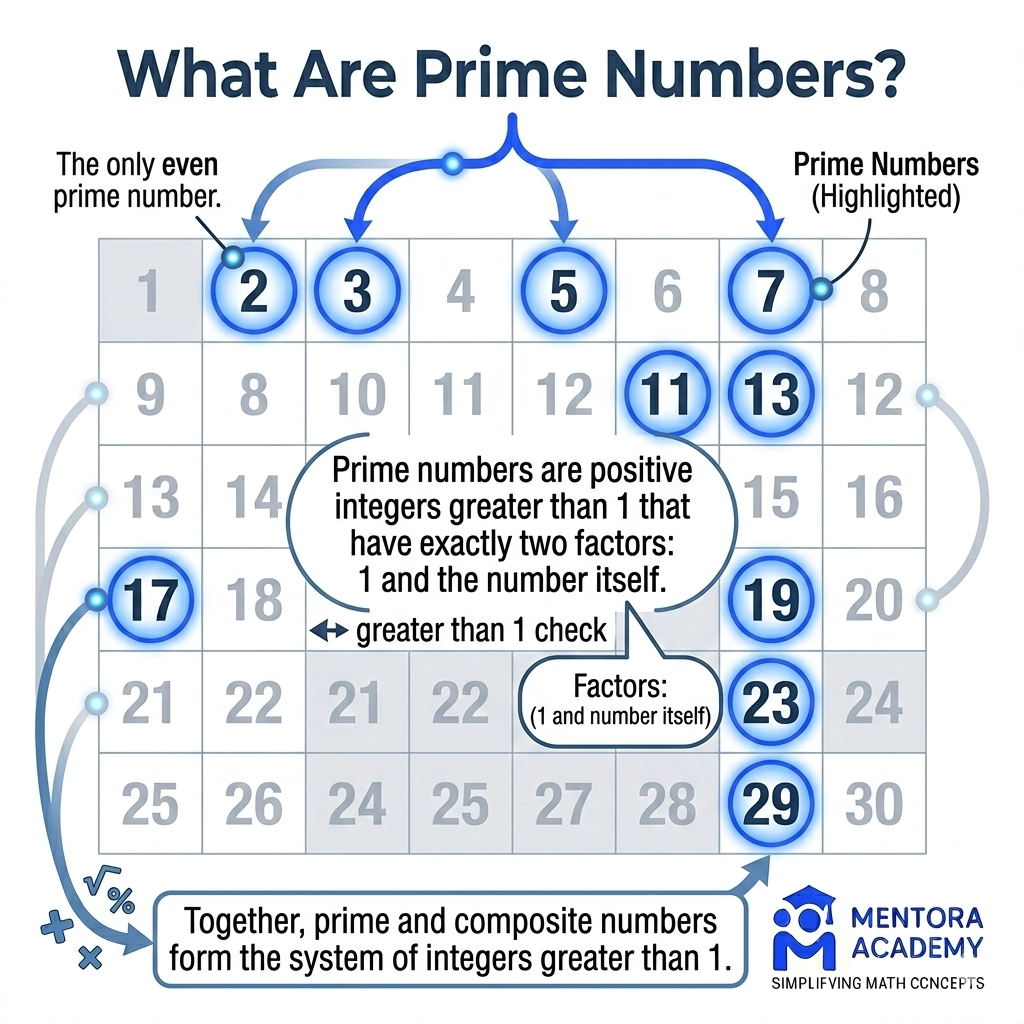
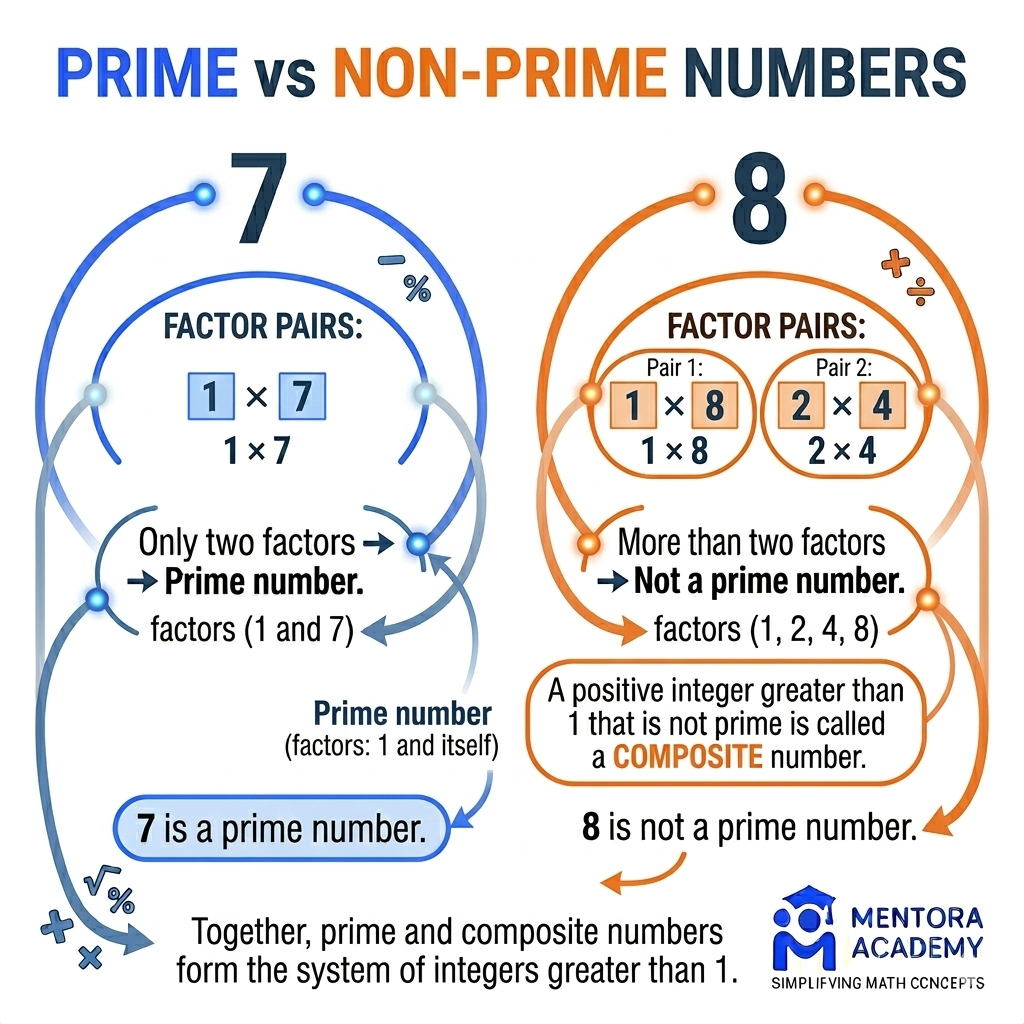
In mathematics, a prime number is a natural number greater than 1 that cannot be formed by multiplying two smaller natural numbers together. More formally:
Definition: A prime number is a natural number p > 1 that has exactly two distinct positive divisors: 1 and p itself.
For example, 7 is prime because the only numbers that divide evenly into 7 are 1 and 7. There’s no other whole number you can multiply to get 7 (besides 1 × 7 or 7 × 1).
On the other hand, composite numbers have more than two factors. Take 12: it has factors of 1, 2, 3, 4, 6, and 12. You can make 12 by multiplying 2 × 6, or 3 × 4, or 2 × 2 × 3. That flexibility makes 12 composite, not prime.
Why Isn’t 1 a Prime Number?
This confuses many students at first. By the definition above, 1 only has ONE divisor (itself), not two. Mathematicians exclude 1 from the prime numbers for a critical reason: it would break many important theorems in number theory, especially the Fundamental Theorem of Arithmetic, which states that every integer greater than 1 can be expressed as a unique product of prime numbers.
If we allowed 1 to be prime, then 12 could be factored as 2 × 2 × 3, or 1 × 2 × 2 × 3, or 1 × 1 × 2 × 2 × 3, losing the « unique » property that makes prime factorization so powerful in mathematics.
What Are the First 100 Prime Numbers?
Here are all 25 prime numbers less than 100:
2, 3, 5, 7, 11, 13, 17, 19, 23, 29, 31, 37, 41, 43, 47, 53, 59, 61, 67, 71, 73, 79, 83, 89, 97
Notice anything interesting? After 2, all prime numbers are odd. Why? Because any even number greater than 2 can be divided by 2, which means it has more than two factors (1, 2, itself, and possibly others). This makes 2 the only even prime—sometimes called « the oddest prime » for this reason!
Prime Number Patterns
While prime numbers may seem random, mathematicians have discovered some fascinating patterns:
- Twin primes: Prime pairs that differ by 2, like (3, 5), (11, 13), (17, 19), and (29, 31)
- Prime gaps: The space between consecutive primes grows larger as numbers get bigger (though irregularly)
- Prime number theorem: The density of primes decreases as numbers increase, but they never stop appearing
- Mersenne primes: Primes of the form 2n – 1, like 3 (2² – 1), 7 (2³ – 1), and 31 (2⁵ – 1)
How to Identify Prime Numbers: 4 Proven Methods
Knowing whether a number is prime is important for math class! Here are four easy methods you can use to check if a number is prime:
Method 1: Trial Division (Best for Small Numbers)
To check if a number n is prime, try dividing it by all prime numbers up to √n. If none divide evenly, it’s prime.
Example: Is 47 prime?
- Find √47 ≈ 6.9
- Test prime divisors less than 6.9: that’s 2, 3, and 5
- 47 ÷ 2 = 23.5 (not divisible)
- 47 ÷ 3 = 15.67 (not divisible)
- 47 ÷ 5 = 9.4 (not divisible)
- Conclusion: 47 is prime!
Why only check up to the square root? If a number has a factor larger than its square root, it must also have a corresponding factor smaller than the square root. So checking up to √n covers all possibilities.
Method 2: Divisibility Rules (Quick Elimination)
Before doing calculations, use these divisibility rules to eliminate composite numbers quickly:
- Divisible by 2: Ends in 0, 2, 4, 6, or 8 → NOT prime (except 2)
- Divisible by 3: Sum of digits is divisible by 3 → NOT prime
- Divisible by 5: Ends in 0 or 5 → NOT prime (except 5)
- Divisible by 11: Alternating sum of digits is divisible by 11 → NOT prime
Example: Is 243 prime?
Sum of digits: 2 + 4 + 3 = 9, which is divisible by 3
Therefore, 243 is divisible by 3 → NOT prime (it’s 35)
Real Montreal Example: Students at Royal West Academy, The Study, Villa Maria, Collège Jean-de-Brébeuf, and Lower Canada College use these divisibility rules to quickly identify composite numbers in their Secondary 1-2 mathematics classes. Once you master these tricks, math homework becomes so much easier!
Method 3: The Sieve of Eratosthenes (Find All Primes Up to N)
This ancient Greek algorithm efficiently finds all primes up to any number. It’s still used in computer programs today!
How it works:
- Write down all numbers from 2 to your target (say, 50)
- Circle 2 (it’s prime), then cross out all multiples of 2
- Circle the next uncrossed number (3), then cross out all its multiples
- Circle the next uncrossed number (5), cross out its multiples
- Continue until you pass √50 ≈ 7
- All remaining uncrossed numbers are prime!
Need help mastering prime numbers and number theory?
📞 Book a free evaluation: (514) 588-7682
Method 4: Pattern Recognition (6k ± 1 Rule)
Here’s a fascinating shortcut: all primes greater than 3 can be expressed as 6k ± 1 (where k is a positive integer).
Why does this work?
Any integer can be written as 6k, 6k+1, 6k+2, 6k+3, 6k+4, or 6k+5.
- 6k is divisible by 6 → composite
- 6k+2 is divisible by 2 → composite
- 6k+3 is divisible by 3 → composite
- 6k+4 is divisible by 2 → composite
That leaves only 6k+1 and 6k+5 (which equals 6k-1). While not all numbers of this form are prime, all primes fit this pattern.
Example:
7 = 6(1) + 1 ✓
11 = 6(2) – 1 ✓
13 = 6(2) + 1 ✓
17 = 6(3) – 1 ✓
What Is Prime Factorization?
Prime factorization is the process of expressing a number as a product of prime numbers. It’s like finding the « DNA » of a number—its most basic mathematical components.
The Fundamental Theorem of Arithmetic
Fundamental Theorem of Arithmetic: Every integer greater than 1 can be expressed as a product of prime numbers in exactly one way (ignoring the order of factors).
This important theorem means that primes are truly the « building blocks » of mathematics—like atoms that make up all other numbers. Learning about prime factorization in Secondary 1-2 gives you a strong foundation for all future math classes!
How to Find Prime Factorization
Example: Find the prime factorization of 72
72 ÷ 2 = 36
36 ÷ 2 = 18
18 ÷ 2 = 9
9 ÷ 3 = 3
3 ÷ 3 = 1
Answer: 72 = 2³ × 3²
Example: Find the prime factorization of 210
210 ÷ 2 = 105
105 ÷ 3 = 35
35 ÷ 5 = 7
7 ÷ 7 = 1
Answer: 210 = 2 × 3 × 5 × 7
Where Are Prime Numbers Used in Real Life?
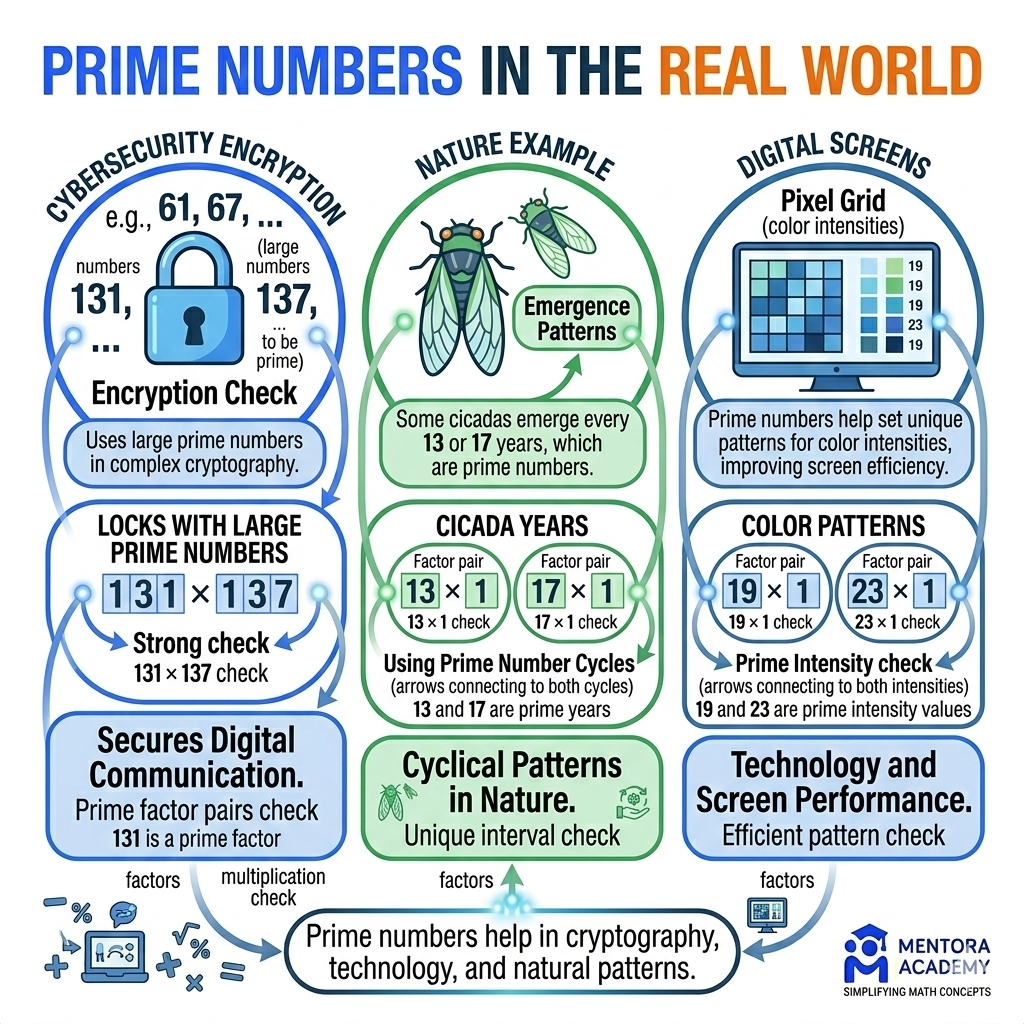
Prime numbers aren’t just abstract concepts—they have practical applications that affect your daily life, especially in Montreal’s growing tech sector!
1. Internet Security and Cryptography
Every time you enter your credit card online or send a private message, prime numbers protect your data. The RSA encryption algorithm uses the multiplication of two large prime numbers to create virtually unbreakable codes. Montreal tech companies like Shopify, Lightspeed, and CGI rely on this encryption daily to protect millions of transactions.
Students at Montreal’s top high schools (including École Secondaire Internationale de Laval, Collège Jean-Eudes, and Villa Maria) who master prime factorization in Secondary 1-2 are building important math skills that could lead to exciting careers in technology and cybersecurity!
2. Computer Science and Hash Tables
Struggling with prime factorization or number theory?
📞 Get expert math help: (514) 588-7682
20 Practice Problems with Complete Solutions
Test your understanding with these progressively challenging problems. Each solution is shown below its problem with a full step-by-step explanation.
Level 1: Identifying Primes (Easy)
Answer: Prime ✓
Answer: Composite (51=3×17) ✓
Answer: 101 ✓
Level 2: Prime Factorization (Medium)
Answer: 2²×3×5 ✓
Level 3: Applications (Challenging)
Answer: 1, 2, 3, 4, 6, 8, 12, 16, 24, 48 ✓
Answer: 4 rotations (18-tooth) and 3 rotations (24-tooth) ✓
Answer: False ✓
Answer: 11×13 ✓
Answer: More composites ✓
Answer: 24 ✓
Answer: Composite ✓
Need help with these practice problems?
📞 Book a free evaluation: (514) 588-7682
Frequently Asked Questions About Prime Numbers
What is a prime number in simple terms?
A prime number is a whole number greater than 1 that can only be divided evenly by 1 and itself. For example, 7 is prime because only 1 and 7 divide into it evenly.
Why is 1 not considered a prime number?
By definition, prime numbers must have exactly TWO distinct factors: 1 and themselves. Since 1 only has one factor (itself), it doesn’t meet this requirement. Excluding 1 also preserves important mathematical theorems like the Fundamental Theorem of Arithmetic.
Is 2 the only even prime number?
Yes! 2 is the only even prime number. All other even numbers can be divided by 2, giving them more than two factors, which makes them composite numbers instead of primes.
How do you know if a large number is prime?
For large numbers, divide by all prime numbers up to the square root of that number. If none divide evenly, it’s prime. For very large numbers, mathematicians use advanced algorithms like the Miller-Rabin primality test.
What is prime factorization?
Prime factorization is breaking down a number into its prime number building blocks. For example, 12 = 2 × 2 × 3. Every number has a unique prime factorization.
Are there infinitely many prime numbers?
Yes! Euclid proved over 2,000 years ago that there are infinitely many prime numbers. No matter how large a prime you find, there’s always a larger one.
What are twin primes?
Twin primes are pairs of prime numbers that differ by exactly 2. Examples include (3,5), (11,13), (17,19), and (29,31). The Twin Prime Conjecture states there are infinitely many twin primes, but this hasn’t been proven yet.
How are prime numbers used in real life?
Prime numbers are crucial for internet security and encryption. RSA encryption, used by banks and online stores, relies on the difficulty of factoring large numbers into their prime components. They’re also used in computer science, hash tables, and even appear in nature (like cicada life cycles).
Finding Prime Numbers Help in Montreal
Looking for expert help with prime numbers in Montreal? Mentora Academy provides in-person and online tutoring across Greater Montreal, including Laval, South Shore, and West Island. Our certified math tutors specialize in Quebec’s Secondary 1-2 curriculum and can help you master prime numbers, factorization, and number theory.
Whether you’re a student in Montreal’s public schools, private institutions, or studying for entrance exams to selective programs, our tutors understand the specific challenges of the Quebec curriculum. We serve students across all Montreal neighborhoods and provide flexible scheduling to accommodate busy student schedules.
🎯 Master Prime Numbers with Expert Montreal Tutors
Join 2,500+ students who improved their math grades
Whether you’re struggling with prime factorization, number theory, or want to excel in your Secondary 1-2 math class, our certified tutors are here to help.
📍 Serving students across Montreal: Westmount, NDG, Côte-des-Neiges, Outremont, Plateau, Downtown, Laval, South Shore, West Island, and surrounding areas
✓ Free evaluation session
✓ Certified expert tutors
✓ Proven results in weeks, not months
Available 7 days/week • Same-day appointments available
Ready to Master This Topic?
Our expert tutors in Montreal can help you succeed.
Book Free Math Evaluation