
Prime Numbers for Kids (2026): Fun Guide | Montreal Tutoring Services
Get personalized tutoring support today.
Call Now: +1-514-588-7682
Quick Summary: Prime Numbers for Kids
- A prime number can only be divided into equal groups in 2 ways
- The number 2 is the smallest prime number
- Numbers like 3, 5, 7, and 11 are prime numbers
- We use objects and drawings to find prime numbers
- Prime numbers are fun to learn with Montreal’s best math tutoring services!
⏱️ Read time: 10 minutes
📑 What You’ll Learn
What is a Prime Number? A Fun Guide for Kids!
Hi there! Are you a student in Grade 3 or Grade 4 in Montreal? Learning about prime numbers is really fun! Whether you go to school in Westmount, NDG, Laval, or anywhere in Montreal, this guide will help you understand prime numbers using simple examples.
A prime number is a special number that can only be divided into equal groups in 2 ways:
Way #1: Put ALL the objects in ONE big group
Way #2: Put ONE object in each group
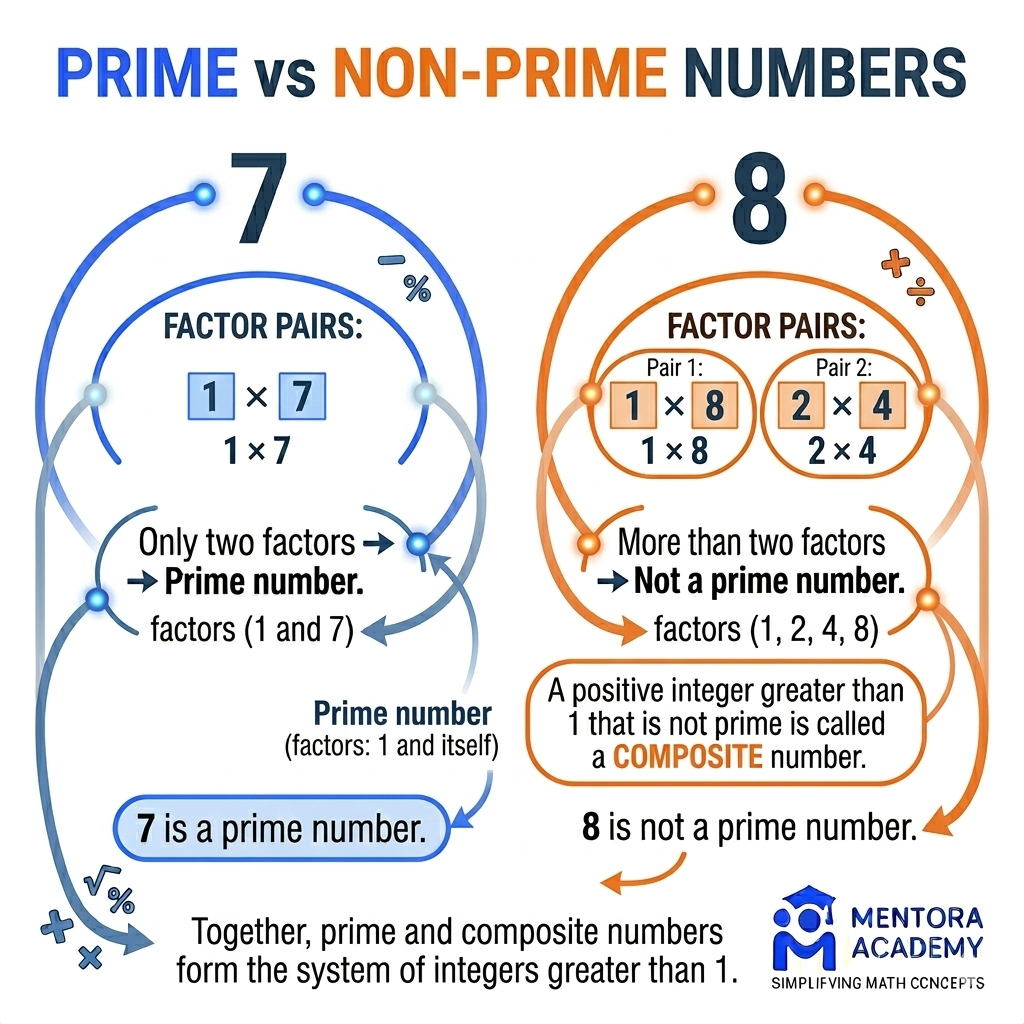
Let’s look at an example! Imagine you have 7 buttons. Can you make equal groups?
🔘 🔘 🔘 🔘 🔘 🔘 🔘
Try making 2 equal groups… Nope! You’d have 1 button left over.
Try making 3 equal groups… Nope! You’d have buttons left over.
Try making 4, 5, or 6 equal groups… Still doesn’t work!
The ONLY ways that work are:
- 1 group of 7 buttons (all together)
- 7 groups of 1 button each (one in each group)
That means 7 is a prime number! ✨
Why Isn’t 1 a Prime Number?
Here’s something tricky: The number 1 is NOT a prime number. Why? Because with just 1 object, you can only make 1 group of 1. That’s only ONE way, not two ways! Remember, prime numbers need TWO different ways to make equal groups.
Also, 0 is not a prime number because you can’t make groups with zero objects!
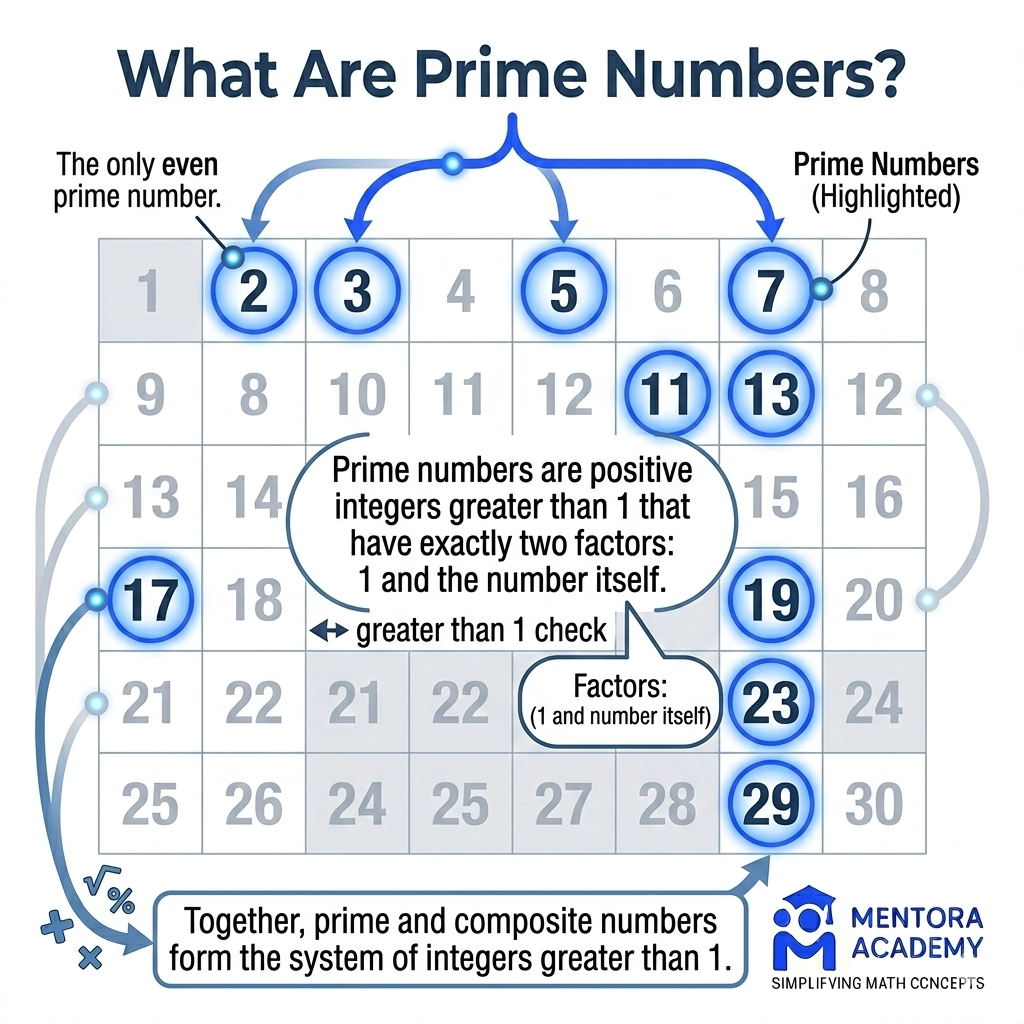
What Are the Prime Numbers From 1 to 30?
Here are all the prime numbers between 1 and 30. Can you spot a pattern?
2, 3, 5, 7, 11, 13, 17, 19, 23, 29
Wow! That’s 10 prime numbers! Notice something cool? After the number 2, all prime numbers are odd numbers. Can you guess why?
It’s because if a number is even (like 4, 6, 8, 10…), you can always make 2 equal groups! So even numbers (except 2) can’t be prime.
Let’s See More Prime Numbers!
Here are prime numbers from 30 to 50:
31, 37, 41, 43, 47
Can you find prime numbers on your own? Try checking the numbers from 50 to 60!
How to Check if a Number is Prime: The Fun Way!
Want to know if a number is prime? Let’s use objects and drawings to find out! This is the best way for kids to learn.
The Equal Groups Method (Perfect for Kids!)
Here’s the easiest way to check if a number is prime:
Step 1: Draw or get that many objects (buttons, stars, dots, etc.)
Step 2: Try to make equal groups in different ways
Step 3: Count how many ways work!
If only 2 ways work → It’s PRIME! ✨
Example: Let’s check if 11 is prime!
Draw 11 stars: ⭐⭐⭐⭐⭐⭐⭐⭐⭐⭐⭐
Can we make 2 equal groups? Nope! (We’d have 1 star left over)
Can we make 3 equal groups? Nope! (Stars left over)
Can we make 4 equal groups? Nope!
Can we make 5 equal groups? Nope!
The ONLY ways that work:
- 1 group of 11 stars ← Way #1
- 11 groups of 1 star each ← Way #2
That’s only 2 ways! So 11 is PRIME! 🎉
Need help with prime numbers? Montreal’s best math tutors can help!
📞 Call for free help: (514) 588-7682
Let’s Try a NON-Prime Number!
Example: Is 12 prime?
Draw 12 circles: ⭕⭕⭕⭕⭕⭕⭕⭕⭕⭕⭕⭕
Can we make 2 equal groups? YES! → ⭕⭕⭕⭕⭕⭕ | ⭕⭕⭕⭕⭕⭕
Can we make 3 equal groups? YES! → ⭕⭕⭕⭕ | ⭕⭕⭕⭕ | ⭕⭕⭕⭕
Can we make 4 equal groups? YES! → ⭕⭕⭕ | ⭕⭕⭕ | ⭕⭕⭕ | ⭕⭕⭕
Wow! We found MORE than 2 ways! That means 12 is NOT prime. We call it a composite number.
What Are More Examples of Prime Numbers?
Let’s practice finding prime numbers using fun examples with objects you can see and touch!
Example 1: Is 5 Prime?
Draw 5 stars: ⭐⭐⭐⭐⭐
Try making equal groups:
- 2 groups? Nope! (1 star left over)
- 3 groups? Nope! (Stars left over)
- 4 groups? Nope!
Only 2 ways work: (1 group of 5) or (5 groups of 1)
Answer: 5 is PRIME! ✓
Example 2: Is 6 Prime?
Draw 6 buttons: 🔘🔘🔘🔘🔘🔘
Try making equal groups:
- 2 groups? YES! → 🔘🔘🔘 | 🔘🔘🔘
- 3 groups? YES! → 🔘🔘 | 🔘🔘 | 🔘🔘
We found MORE than 2 ways!
Answer: 6 is NOT prime (it’s composite) ✗
Example 3: Is 13 Prime?
Imagine you have 13 candies: 🍬🍬🍬🍬🍬🍬🍬🍬🍬🍬🍬🍬🍬
Can you share them equally between 2 friends? Nope!
Can you share them equally between 3 friends? Nope!
Can you share them equally between 4, 5, or 6 friends? Nope!
Only 2 ways work: Keep all 13 for yourself, or give 1 to each of 13 friends!
Answer: 13 is PRIME! ✓
Want to get better at math? Our Montreal tutors make it fun and easy!
📞 Call now: (514) 588-7682
10 Fun Practice Problems for Kids!
Now it’s your turn! Try these fun problems to practice what you learned. Click « Show Answer » to check your work!
Easy Problems (Great for Grade 3!)
Problem 1: Is 3 prime or composite?
Answer: PRIME! ✓
You can only make 1 group of 3 or 3 groups of 1. That’s 2 ways!
Problem 2: Is 9 prime or composite?
Answer: COMPOSITE ✗
You can make 3 groups of 3! That’s more than 2 ways.
Problem 3: Circle the prime numbers: 2, 4, 5, 6, 8, 10
Answer: 2 and 5 are prime! ✓
Problem 4: What is the smallest prime number?
Answer: 2 ✓
It’s also the only even prime number!
Problem 5: Is 4 prime or composite?
Answer: COMPOSITE ✗
You can make 2 groups of 2! Plus 1 group of 4 and 4 groups of 1.
Medium Problems (Perfect for Grade 4!)
Problem 6: Is 17 prime or composite?
Answer: PRIME! ✓
Try it! You can’t make equal groups except 1 group of 17 or 17 groups of 1.
Problem 7: List all prime numbers between 10 and 20.
Answer: 11, 13, 17, 19 ✓
That’s 4 prime numbers!
Problem 8: Is 15 prime or composite?
Answer: COMPOSITE ✗
You can make 3 groups of 5, or 5 groups of 3! That’s more than 2 ways.
Problem 9: Is 23 prime or composite?
Answer: PRIME! ✓
You can only make 1 group of 23 or 23 groups of 1!
Problem 10: You have 8 cookies. Can you share them equally with 3 friends?
Answer: NO! ✗
8 is NOT divisible by 3. Someone would get extra cookies!
(Also, 8 is composite because you can make 2 groups of 4!)
Need help with these practice problems?
📞 Book a free evaluation: (514) 588-7682
Questions Parents Ask About Prime Numbers
What grade do kids learn prime numbers in Montreal?
In Montreal, students typically learn about prime numbers in Grade 3 and Grade 4 as part of the Quebec elementary math curriculum. This builds their foundation for multiplication and division concepts.
How can I help my child understand prime numbers at home?
Use everyday objects like buttons, candies, or toys! Have your child try making equal groups. If they can only make 2 ways (all together or one in each group), it’s prime! This hands-on approach makes learning fun and memorable.
Why is 1 not a prime number?
The number 1 is special! For a number to be prime, it needs exactly TWO ways to make equal groups. With 1, there’s only ONE way: 1 group of 1. So 1 is neither prime nor composite.
Is 2 a prime number even though it’s even?
Yes! 2 is the only even prime number. All other even numbers can be divided into 2 equal groups, giving them more than 2 ways. But 2 can only be 1 group of 2 or 2 groups of 1.
What’s the easiest way for kids to identify prime numbers?
The « equal groups » method is perfect for elementary students! Draw or use objects, then try making equal groups in different ways. If only 2 ways work (all in one group, or one in each group), it’s prime!
Where can I find elementary math tutoring in Montreal?
Mentora Academy offers specialized elementary math tutoring for Grades 3-4 students across Montreal, including Westmount, NDG, Laval, and surrounding areas. Our tutors make math fun and build strong foundations in prime numbers and other concepts.
Elementary Math Tutoring in Montreal
Is your child in Grade 3 or Grade 4 and struggling with prime numbers? Mentora Academy provides fun, engaging math tutoring for elementary students across Greater Montreal, including Westmount, NDG, Laval, South Shore, and West Island.
Our experienced tutors make math fun for young learners! We use games, objects, and visual activities to help kids understand prime numbers and build confidence in math. Whether your child attends public school or private school in Montreal, we understand the Quebec elementary curriculum and can help them succeed.
We serve families across Montreal: Westmount, NDG, Côte-des-Neiges, Outremont, Ville-Marie, Laval, Brossard, Longueuil, and all surrounding areas. Flexible scheduling available to fit your family’s busy schedule!
🎯 Help Your Child Master Prime Numbers!
Join 2,500+ Montreal families who trust Mentora Academy
Is your Grade 3 or Grade 4 student struggling with prime numbers or other math concepts? Our patient, experienced tutors make learning fun and help kids build confidence!
📍 Serving families across Montreal: Westmount, NDG, Côte-des-Neiges, Outremont, Laval, Brossard, Longueuil, and all surrounding areas
✓ Free evaluation session
✓ Patient, kid-friendly tutors
✓ Fun, engaging lessons your child will love
Available 7 days/week • Book your free evaluation today!
Ready to Master This Topic?
Our expert tutors in Montreal can help you succeed.
Book Free Math Evaluation