
Congruent Angles: Definition, Symbol & Practice Problems
Get personalized tutoring support today.
Call Now: +1-514-588-7682
Quick Summary: Congruent Angles
- Angles with equal measures (same number of degrees)
- Symbol: ≅ (congruence symbol)
- Different from equal – congruent means same shape & size
- Found in vertical angles, parallel lines, regular polygons
- Essential for geometry proofs
Congruent angles are angles that have the exact same measure in degrees — if two angles both measure 45°, they’re congruent, no matter how they’re oriented, positioned, or how long their sides are drawn. Geometry uses the special symbol ≅ to show this (« ∠A ≅ ∠B »), reserving the plain equals sign for the numeric measures themselves (« m∠A = m∠B »).
Still wondering what makes angles « congruent » versus just « equal »? This guide walks through the definition, the notation, and how to solve problems with confidence.
What Is the Definition of Congruent Angles?
Congruent angles are angles that have the same measure. If two angles both measure 45°, they are congruent—regardless of their orientation, position, or the length of their sides.
Key Rule: Two angles are congruent if and only if they have equal measures.
If ∠A = 60° and ∠B = 60°, then ∠A ≅ ∠B
Important distinction:
- Congruent (≅): Same shape and size (used for geometric figures)
- Equal (=): Same numerical value (used for measures/numbers)
- We say: « ∠A is congruent to ∠B » → ∠A ≅ ∠B
- We say: « The measure of ∠A equals the measure of ∠B » → m∠A = m∠B
What Is the Symbol for Congruent Angles?
The congruence symbol is ≅ (an equals sign with a tilde/wavy line on top).
How to write it:
- ∠ABC ≅ ∠DEF means « angle ABC is congruent to angle DEF »
- This tells us: m∠ABC = m∠DEF (their measures are equal)
- Never write: ∠ABC = ∠DEF (angles aren’t equal, they’re congruent!)
- Do write: m∠ABC = m∠DEF (measures can be equal)
What Do Congruent Angles Look Like?
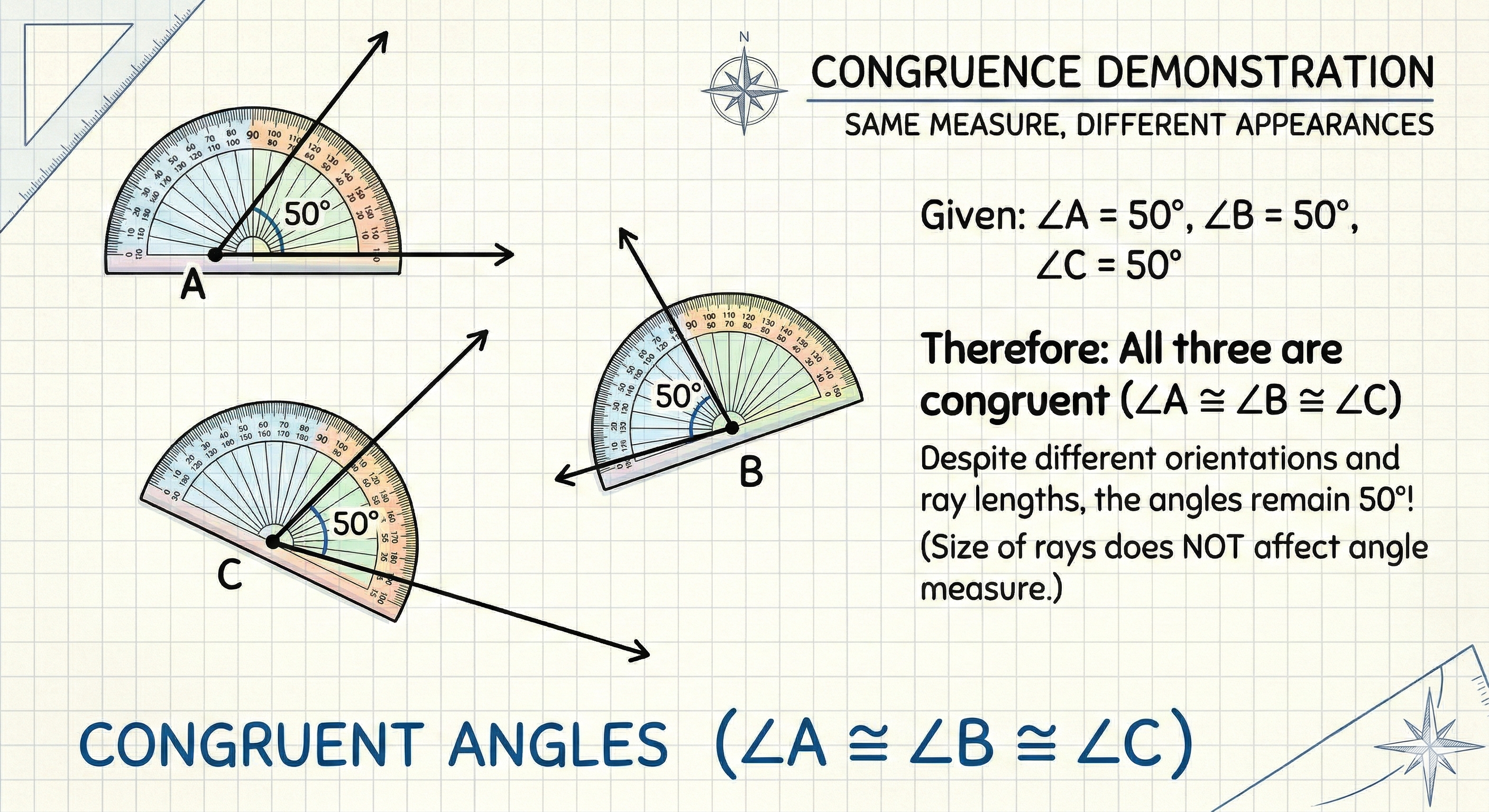
In the diagram above:
- ∠A = 50°, ∠B = 50°, ∠C = 50°
- Therefore: ∠A ≅ ∠B ≅ ∠C (all three are congruent)
- Even though they face different directions, they’re all 50°
- The length of the angle’s sides doesn’t matter—only the measure!
What Type of Angles Are Congruent?
Certain angle relationships always create congruent angles. Understanding these patterns is key to solving geometry problems quickly!
1. Vertical Angles
When two lines intersect, they form 4 angles. The angles that are opposite each other are called vertical angles, and these are always congruent.
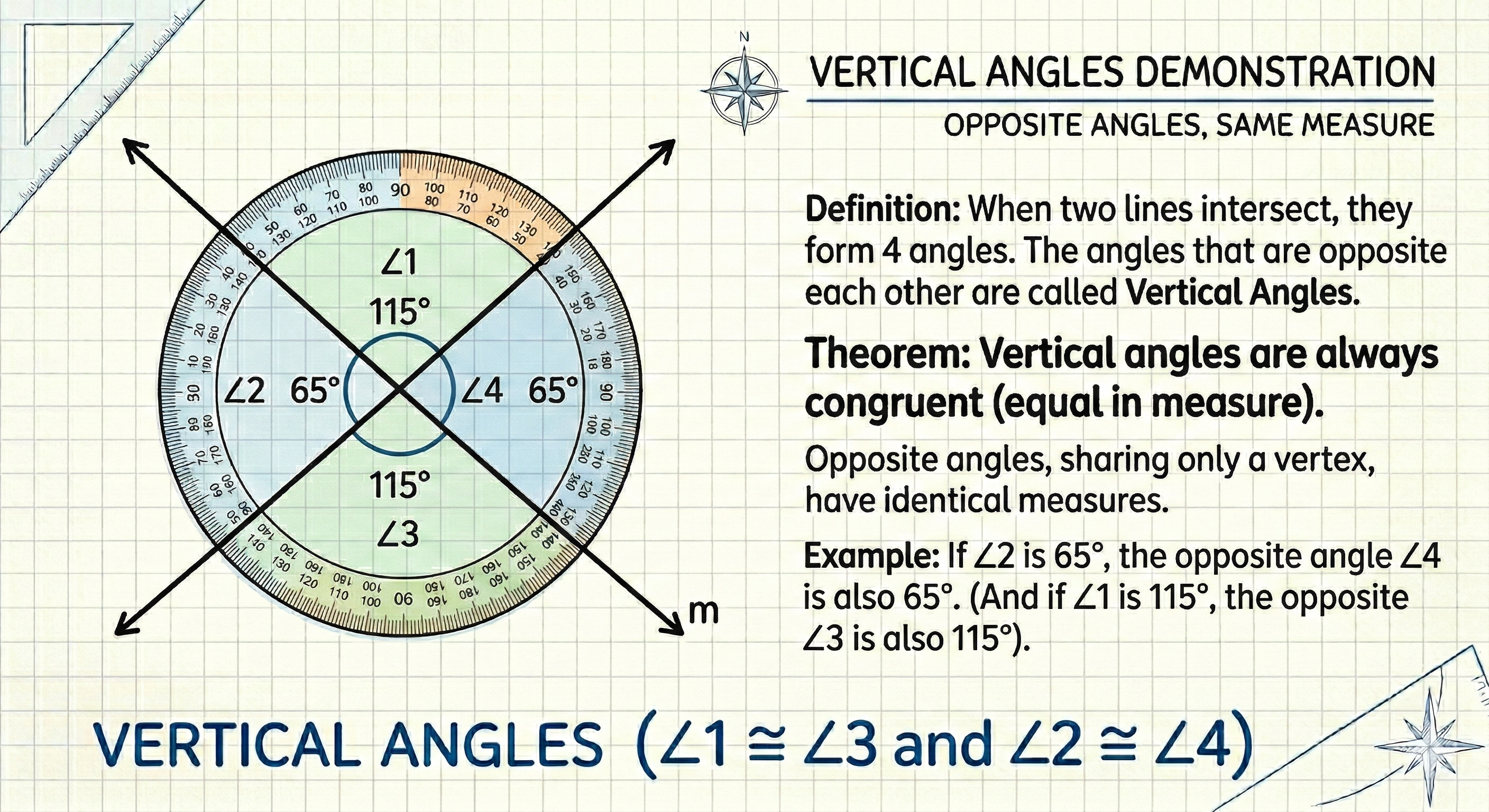
Example: If two lines cross and one angle is 65°, the angle opposite to it is also 65°.
Key Rule: Vertical angles are ALWAYS congruent, no matter what the angle measure is.
2. Alternate Angles (Parallel Lines)
When a line (transversal) intersects two parallel lines, it forms several pairs of congruent angles:
[IMAGE: Transversal crossing two parallel lines, with alternate interior and exterior angles marked]
Congruent angle pairs:
- Alternate interior angles (inside the parallel lines, opposite sides)
- Alternate exterior angles (outside the parallel lines, opposite sides)
- Corresponding angles (same position on each parallel line)
Example: If one alternate interior angle is 110°, its pair is also 110°.
3. Isosceles Triangles
In an isosceles triangle, two sides are equal in length. The angles opposite those equal sides (called base angles) are always congruent.
[IMAGE: Isosceles triangle with two equal sides marked and base angles highlighted]
Example: If an isosceles triangle has base angles, and one measures 55°, the other also measures 55°.
Important: If you see two congruent angles in a triangle, you know it’s isosceles!
4. Equilateral Triangles
In an equilateral triangle, all three sides are equal. This means all three internal angles are congruent and each always measures 60°.
[IMAGE: Equilateral triangle with all three 60° angles marked]
Key fact: Every equilateral triangle has three congruent 60° angles—no exceptions!
5. Squares and Rectangles
In squares and rectangles, all four internal angles are congruent and each measures 90° (right angles).
[IMAGE: Square and rectangle with all four 90° angles marked]
Why: These are special quadrilaterals where perpendicular sides create four right angles.
6. Regular Polygons
In any regular polygon (where all sides are equal), all internal angles are congruent.
Examples:
- Regular pentagon: All five angles = 108° each
- Regular hexagon: All six angles = 120° each
- Regular octagon (stop sign): All eight angles = 135° each
How Do You Find Congruent Angles?
There are several methods to determine if angles are congruent:
Method 1: Direct Measurement
Steps:
- Use a protractor to measure the first angle
- Measure the second angle the same way
- If both measurements are equal, the angles are congruent
Example: If ∠A measures 47° and ∠B measures 47°, then ∠A ≅ ∠B
Method 2: Use Geometric Properties
You can identify congruent angles without measuring by recognizing special relationships:
| Situation | Congruent Angles | Why? |
|---|---|---|
| Two lines intersect | Vertical angles | Vertical Angles Theorem |
| Transversal crosses parallel lines | Corresponding, alternate interior, alternate exterior | Parallel Lines Postulate |
| Triangle with two equal sides | Base angles | Isosceles Triangle Theorem |
| Triangle with three equal sides | All three angles (60° each) | Equilateral Triangle Property |
| Square or rectangle | All four angles (90° each) | Right Angle Property |
Method 3: Look for Angle Markings
In geometry diagrams, congruent angles are often indicated with matching marks:
- Single arc (⌒): All angles with one arc are congruent to each other
- Double arc (⌒⌒): All angles with double arcs are congruent to each other
- Triple arc (⌒⌒⌒): All angles with triple arcs are congruent to each other
[IMAGE: Multiple angles with matching arc marks showing congruence]
Method 4: Solve Algebraically
If angles are described with expressions, set them equal and solve for the variable.
Example:
If ∠A = (3x + 10)° and ∠B = (5x – 30)°, and they’re congruent:
3x + 10 = 5x – 30
40 = 2x
x = 20
Both angles = 70°
How Do You Construct a Congruent Angle?
You can construct an angle congruent to a given angle using a compass and straightedge. This is a fundamental geometric construction.
Steps to Construct a Congruent Angle:
Given: Angle ABC that you want to copy
Step 1: Draw a ray
Draw a ray (starting point D with ray DE) where you want the congruent angle.
[IMAGE: Step 1 – Original angle ABC and new ray DE]
Step 2: Draw an arc on the original angle
Place your compass point on vertex B of the original angle. Draw an arc that intersects both sides of the angle. Label the intersection points P and Q.
[IMAGE: Step 2 – Arc intersecting both sides of angle ABC at points P and Q]
Step 3: Copy the arc to the new ray
Without changing the compass width, place the compass on point D and draw a similar arc that intersects ray DE. Label this intersection point F.
[IMAGE: Step 3 – Same arc drawn from point D, intersecting at F]
Step 4: Measure the distance between arc intersections
Place your compass on point P and adjust it to reach point Q (on the original angle). This captures the « opening » of the angle.
[IMAGE: Step 4 – Compass measuring distance from P to Q]
Step 5: Transfer this distance
Keeping the same compass width, place the compass on point F (on your new angle) and draw an arc that intersects the previous arc. Label this new intersection point G.
[IMAGE: Step 5 – Arc from F creating intersection point G]
Step 6: Draw the second side
Draw a ray from D through G. Angle FDG is now congruent to angle ABC!
[IMAGE: Step 6 – Completed congruent angle FDG]
✓ Result: You’ve constructed ∠FDG ≅ ∠ABC using only a compass and straightedge!
Why This Works:
This construction creates two triangles (in the original and new angles) with three congruent sides (SSS congruence). Since the triangles are congruent, their corresponding angles must also be congruent!
Practical Tip:
When constructing congruent angles:
- Keep your compass width fixed between steps 2 and 3
- Keep your compass width fixed between steps 4 and 5
- Draw arcs large enough to clearly see intersection points
- Use a sharp pencil for precision
Which Angle Types Are Always Congruent?
| Type | Description | Example | Always Congruent? |
|---|---|---|---|
| Vertical Angles | Opposite angles when two lines intersect | ∠1 ≅ ∠3, ∠2 ≅ ∠4 | ✅ Yes (always) |
| Corresponding Angles | Same position with parallel lines | When lines are parallel | ✅ Yes (if parallel) |
| Alternate Interior | Z-pattern with parallel lines | Between parallel lines | ✅ Yes (if parallel) |
| Base Angles | Isosceles triangle | Two equal sides → two equal angles | ✅ Yes (in isosceles) |
| All Angles | Equilateral triangle | All three angles = 60° | ✅ Yes (in equilateral) |
| Right Angles | All 90° angles | All right angles are congruent | ✅ Yes (all 90°) |
Practice Problems
Basic Problems
- Problem 1: If ∠A = 75° and ∠B = 75°, are they congruent?
Solution: Yes, ∠A ≅ ∠B
They have the same measure, so they’re congruent.
Notation: ∠A ≅ ∠B and m∠A = m∠B = 75° - Problem 2: If ∠X ≅ ∠Y and m∠X = 42°, find m∠Y.
Solution: m∠Y = 42°
Congruent angles have equal measures.
Check: ✓ - Problem 3: True or False: All acute angles are congruent.
Solution: FALSE
Acute angles are less than 90°, but they can have different measures (30°, 45°, 60°, etc.). Only angles with the SAME measure are congruent. - Problem 4: Two vertical angles are formed. One measures 118°. What is the measure of the other?
Solution: 118°
Vertical angles are always congruent, so the other angle also measures 118°.
Check: ✓
Intermediate Problems
- Problem 5: If ∠P ≅ ∠Q and m∠P = (3x + 20)° while m∠Q = (5x – 30)°, find x and the measure of both angles.
Solution:
Since the angles are congruent, their measures are equal:
3x + 20 = 5x – 30
20 + 30 = 5x – 3x
50 = 2x
x = 25
m∠P: 3(25) + 20 = 95°
m∠Q: 5(25) – 30 = 95°
Check: Both angles = 95°, so ∠P ≅ ∠Q ✓ - Problem 6: In triangle ABC, ∠A ≅ ∠B. If m∠A = 65°, what type of triangle is ABC?
Solution:
Since ∠A ≅ ∠B, the triangle has two congruent angles.
By the Isosceles Triangle Theorem, if two angles are congruent, the sides opposite them are also congruent.
Answer: Triangle ABC is isosceles
Check: ✓ - Problem 7: Two angles are congruent. One is represented by (4x – 10)° and the other by (2x + 40)°. Are these angles acute, right, or obtuse?
Solution:
4x – 10 = 2x + 40
4x – 2x = 40 + 10
2x = 50
x = 25
Angle measure: 4(25) – 10 = 90°
Answer: Both angles are right angles (90°)
Check: 2(25) + 40 = 90° ✓
Advanced Problems
- Problem 8: Prove: If two angles are both congruent to a third angle, then they are congruent to each other.
Proof:
Given: ∠A ≅ ∠C and ∠B ≅ ∠C
Prove: ∠A ≅ ∠BStatement | Reason
1. ∠A ≅ ∠C | Given
2. m∠A = m∠C | Definition of congruent angles
3. ∠B ≅ ∠C | Given
4. m∠B = m∠C | Definition of congruent angles
5. m∠A = m∠B | Transitive property of equality
6. ∠A ≅ ∠B | Definition of congruent angles
∴ ∠A ≅ ∠B Q.E.D. ✓ - Problem 9: In a diagram, ∠1 and ∠2 are vertical angles. ∠3 and ∠4 are also vertical angles. If ∠1 ≅ ∠3, prove that ∠2 ≅ ∠4.
Proof:
Given: ∠1 ≅ ∠3
Prove: ∠2 ≅ ∠4Statement | Reason
1. ∠1 and ∠2 are vertical angles | Given
2. ∠1 ≅ ∠2 | Vertical Angles Theorem
3. ∠3 and ∠4 are vertical angles | Given
4. ∠3 ≅ ∠4 | Vertical Angles Theorem
5. ∠1 ≅ ∠3 | Given
6. ∠2 ≅ ∠4 | Transitive property (from steps 2, 5, 4)
∴ ∠2 ≅ ∠4 Q.E.D. ✓ - Problem 10: Three angles are congruent. Their sum is 180°. Find the measure of each angle.
Solution:
Let each angle = x
x + x + x = 180°
3x = 180°
x = 60°
Each angle = 60°
Note: This forms an equilateral triangle!
Check: 60° + 60° + 60° = 180° ✓
What Mistakes Do Students Make With Congruent Angles?
❌ Mistake #1: Confusing congruent (≅) with equal (=)
WRONG: « ∠A = ∠B »
CORRECT: « ∠A ≅ ∠B » (angles are congruent)
ALSO CORRECT: « m∠A = m∠B » (measures are equal)
❌ Mistake #2: Thinking congruent angles must look the same
WRONG: « Angles must have the same orientation to be congruent »
CORRECT: Congruent angles can face any direction—only the measure matters!
❌ Mistake #3: Confusing congruent angles with supplementary angles
Remember:
– Congruent angles: Have the same measure (can be any value)
– Supplementary angles: Add up to 180° (can have different measures)
❌ Mistake #4: Assuming all angles in a shape are congruent
WRONG: « All triangles have congruent angles »
CORRECT: Only equilateral triangles have all angles congruent (60° each). Other triangles have different angle measures.
Where Do You See Congruent Angles in Real Life?
Example 1: Clock Hands
At 3:00 and 9:00, the angle between the hour and minute hands is 90° both times. These angles are congruent, even though the clock hands point in different directions.
Example 2: Architecture
Windows in a building often have congruent angles to maintain symmetry. The corners of rectangular windows are all 90° (congruent right angles) — look at the matching window grids on Hampstead’s mid-century homes and every corner is the same congruent right angle.
Example 3: Road Intersections
When two streets cross at the same angle, the vertical angles formed are congruent. This helps with traffic flow planning and visibility, which is easy to spot in Ahuntsic’s grid of perpendicular residential streets.
Example 4: Pattern Design
Tessellations (repeating patterns like in tiles) use congruent angles to ensure pieces fit together perfectly without gaps.
Example 5: Regular Polygons
All interior angles of a regular polygon (like a stop sign octagon) are congruent, giving it symmetry and balance.
Why Do Congruent Angles Matter in Math?
Understanding congruent angles is essential for:
- Geometry proofs: Many theorems rely on angle congruence
- Triangle classification: Identifying isosceles and equilateral triangles
- Parallel lines: Proving lines are parallel using angle relationships
- Polygon properties: Understanding regular shapes
- Quebec curriculum: Core concept in Secondary 2-4 geometry
- Real-world applications: Engineering, architecture, design
How Are Congruent Angles Used in Proofs?
Common proof strategies using congruent angles:
- Vertical Angles Theorem: Vertical angles are congruent
- Isosceles Triangle Theorem: Base angles are congruent
- Corresponding Angles Postulate: When lines are parallel
- Transitive Property: If ∠A ≅ ∠B and ∠B ≅ ∠C, then ∠A ≅ ∠C
- Reflexive Property: Any angle is congruent to itself (∠A ≅ ∠A)
- Symmetric Property: If ∠A ≅ ∠B, then ∠B ≅ ∠A
What Other Angle Types Should You Learn Next?
Now that you understand congruent angles, learn about:
- Vertical Angles – always congruent opposite angles
- Corresponding Angles – congruent when lines are parallel
- Alternate Interior Angles – congruent with parallel lines
- Supplementary Angles – add to 180° (different concept)
Summary
Key Takeaways:
- Congruent angles have equal measures (same number of degrees)
- Symbol: ≅ (not = for angles, only for measures)
- Vertical angles are always congruent
- All right angles are congruent (all 90°)
- Congruent angles can have any orientation or position
- Essential for geometry proofs and triangle properties
Frequently Asked Questions (FAQ)
❓ What are congruent angles?
Answer: Congruent angles are angles that have the exact same measure in degrees. If two angles both measure 50°, they are congruent regardless of their orientation or position.
❓ What is the symbol for congruent angles?
Answer: The congruence symbol is ≅ (an equals sign with a wavy line on top). We write ∠A ≅ ∠B to mean angle A is congruent to angle B.
❓ What’s the difference between congruent and equal?
Answer: Congruent (≅) describes geometric figures with the same shape and size. Equal (=) describes numerical values. For angles: ∠A ≅ ∠B means the angles are congruent, while m∠A = m∠B means their measures are equal.
❓ Are vertical angles always congruent?
Answer: Yes, vertical angles are always congruent. When two lines intersect, the opposite angles formed are called vertical angles and they always have equal measures.
❓ Are all right angles congruent?
Answer: Yes, all right angles are congruent because they all measure exactly 90 degrees. This is an important property used in many geometry proofs.
🎯 Struggling with Geometry? We Can Help!
Get expert math tutoring today
Join 2,500+ Montreal students who improved their grades
✓ Free evaluation session
✓ Certified expert tutors
✓ Proven results in weeks
Available 7 days/week • Same-day appointments • Satisfaction guaranteed
Ready to Master This Topic?
Our expert tutors in Montreal can help you succeed.
Book Free Math Evaluation