
What Are Vertical Angles? Definition, Theorem & Practice Problems
Get personalized tutoring support today.
Call Now: +1-514-588-7682
Quick Summary: Vertical Angles
- Opposite angles formed when two lines intersect
- Always equal in measure (congruent)
- NOT adjacent (don’t share a side)
- Form two pairs of vertical angles at every intersection
Vertical angles are the pair of opposite angles formed whenever two straight lines cross each other. They are always equal in measure (congruent) — this is known as the Vertical Angles Theorem — and, despite the name, they don’t need to point up and down; « vertical » refers to the shared vertex, not the direction.
Still mixing up vertical angles with adjacent angles? This guide covers the definition, the theorem, and how to solve problems with either type.
What Is the Definition of Vertical Angles?
Vertical angles are the opposite angles formed when two lines intersect. They are always congruent (equal in measure).
Key theorem:
Vertical Angles Theorem: Vertical angles are always congruent (equal).
Important: Despite the name « vertical, » these angles don’t have to be in a vertical position. The term comes from the fact that they share a common vertex (the point where lines intersect).
What Do Vertical Angles Look Like?
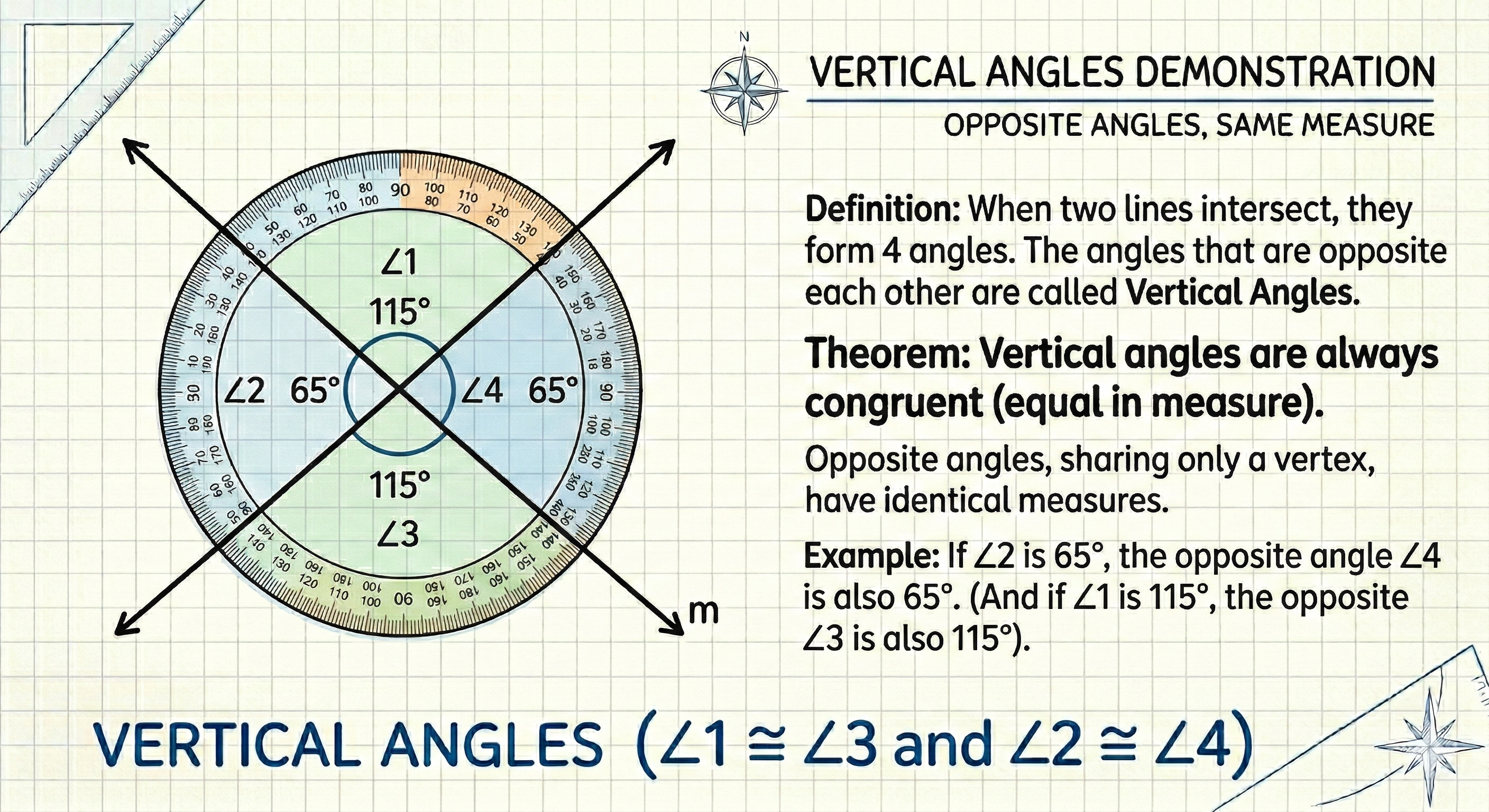
When two lines intersect, they form four angles. In the diagram above:
- ∠1 and ∠3 are vertical angles (opposite each other) → ∠1 = ∠3
- ∠2 and ∠4 are vertical angles (opposite each other) → ∠2 = ∠4
- ∠1 and ∠2 are adjacent (share a side) → NOT vertical angles
- ∠3 and ∠4 are adjacent (share a side) → NOT vertical angles
How Do You Identify Vertical Angles?
How to Spot Them:
- Look for two intersecting lines
- Find the angles that are across from each other
- They should NOT share a side
- They are equal in measure
Example with Measures:
[IMAGE: Two lines crossing, with one angle marked 65°]
If one angle is 65°, what are the other angles?
- Vertical angle opposite to 65° = 65° (vertical angles are equal)
- Adjacent angles = 180° – 65° = 115° (linear pairs sum to 180°)
- Other vertical angle = 115°
Result: Four angles measuring 65°, 115°, 65°, 115° (two pairs of vertical angles)
Where Do You See Vertical Angles in Real Life?
Example 1: Scissors
When you partially open scissors, the blades and handles form two intersecting lines. The angles opposite each other (blade-to-blade and handle-to-handle) are vertical angles and equal.
Example 2: Street Intersection
When two streets cross, they form four corners. The corners directly across from each other are vertical angles with equal measures — easy to picture at any four-way stop in NDG.
Example 3: Railroad Crossing
Where railroad tracks cross a road, the opposite angles formed are vertical angles – always equal to each other, like where the rail line cuts across the streets of Villeray.
Example 4: Letter X
The letter « X » is a perfect example of intersecting lines. The top-left and bottom-right angles are vertical angles, as are the top-right and bottom-left angles.
What Is the Vertical Angles Theorem?
📐 Vertical Angles Theorem:
If two lines intersect, then the vertical angles formed are congruent (equal in measure).
Why are vertical angles always equal?
Here’s the proof:
- When two lines intersect, they form linear pairs (adjacent angles on a straight line)
- Linear pairs are supplementary (sum to 180°)
- If ∠1 + ∠2 = 180° and ∠2 + ∠3 = 180°
- Then ∠1 = ∠3 (both equal 180° – ∠2)
- Therefore, vertical angles are equal!
What Are the Key Properties of Vertical Angles?
✅ Vertical angles are always congruent (equal)
✅ Formed by two intersecting lines
✅ Located opposite each other (across the intersection)
✅ Do NOT share a side (not adjacent)
✅ Two pairs formed at each intersection
❌ NOT necessarily in a vertical position
How Do Vertical Angles Compare to Adjacent Angles and Linear Pairs?
| Type | Position | Relationship | Share a Side? |
|---|---|---|---|
| Vertical Angles | Opposite (across intersection) | Always equal | ❌ No |
| Adjacent Angles | Side-by-side | Any relationship | ✅ Yes |
| Linear Pair | Adjacent on a line | Sum to 180° | ✅ Yes |
How Do You Solve Vertical Angles Problems?
Step-by-step approach:
- Identify the intersection point where lines cross
- Locate the four angles formed
- Identify the pairs: Angles opposite each other are vertical
- Set them equal: Vertical angles have the same measure
- Solve for unknowns: Use algebra if needed
What Mistakes Do Students Make With Vertical Angles?
❌ Mistake #1: Thinking « vertical » means up and down
WRONG: « Vertical angles must point up and down »
CORRECT: « Vertical » refers to the vertex (intersection point), not direction
❌ Mistake #2: Confusing vertical with adjacent angles
WRONG: « Any two angles at an intersection are vertical »
CORRECT: Only opposite angles are vertical; side-by-side angles are adjacent
❌ Mistake #3: Forgetting vertical angles are always equal
WRONG: « Vertical angles can have different measures »
CORRECT: Vertical angles are always congruent (Vertical Angles Theorem)
❌ Mistake #4: Mixing up vertical angles and linear pairs
Key difference: Vertical angles are equal, linear pairs sum to 180°
Practice Problems
Basic Problems
- Problem 1: Two lines intersect. One angle measures 50°. What is the measure of the vertical angle?
Solution: Vertical angles are equal → 50°
Check: Vertical angles are always congruent ✓ - Problem 2: At an intersection, if one angle is 120°, what are the measures of all four angles?
Solution:
– First angle: 120°
– Vertical to first: 120° (vertical angles equal)
– Adjacent angles: 180° – 120° = 60° (linear pairs)
– Other vertical angle: 60°
Answer: 120°, 60°, 120°, 60° ✓ - Problem 3: True or False: Vertical angles are always adjacent.
Solution: FALSE – Vertical angles are opposite each other and do NOT share a side. They are never adjacent.
Intermediate Problems
- Problem 4: Two lines intersect. One angle is (3x + 15)° and its vertical angle is (5x – 25)°. Find x and the angle measures.
Solution:
Since vertical angles are equal:
3x + 15 = 5x – 25
15 + 25 = 5x – 3x
40 = 2x
x = 20
Angle measure: 3(20) + 15 = 75°
Check: 5(20) – 25 = 75° ✓ - Problem 5: Two intersecting lines form four angles. Two vertical angles are represented by (2x + 10)° and (3x – 20)°. Find all four angle measures.
Solution:
2x + 10 = 3x – 20
30 = x
First pair: 2(30) + 10 = 70°
Second pair: 180° – 70° = 110°
All four angles: 70°, 110°, 70°, 110° ✓ - Problem 6: If vertical angles are (4x)° and (2x + 40)°, what is the value of x?
Solution:
4x = 2x + 40
2x = 40
x = 20
Angles: 4(20) = 80°
Check: 2(20) + 40 = 80° ✓
Advanced Problems
- Problem 7: Two lines intersect. One angle is three times another angle. Find all four angle measures.
Solution:
Let smaller angle = x
Larger angle = 3x
These are adjacent (linear pair): x + 3x = 180°
4x = 180°
x = 45°
Four angles: 45°, 135°, 45°, 135°
Check: 3(45°) = 135° ✓ and each vertical pair matches ✓ - Problem 8: Lines AB and CD intersect at point E. ∠AEC = (7x – 10)° and ∠BED = (5x + 30)°. Find the measure of ∠AED.
Solution:
∠AEC and ∠BED are vertical angles:
7x – 10 = 5x + 30
2x = 40
x = 20
∠AEC = 7(20) – 10 = 130°
∠AED is adjacent to ∠AEC (linear pair):
∠AED = 180° – 130° = 50° - Problem 9: Three lines intersect at a single point, forming six angles. Is the vertical angles theorem still valid?
Solution: YES – The vertical angles theorem still holds. Each pair of lines through the point forms its own pair of vertical angles, so with three lines you get 3 pairs of vertical angles (one pair per line-pair) instead of just 1. Every angle is still equal to the angle directly opposite it across the shared point.
Challenge Problems
- Problem 10: Prove algebraically that if two angles are vertical, they must be equal.
Solution (Proof):
Given: Lines AB and CD intersect at point E
Let ∠1 and ∠2 be adjacent angles
Let ∠3 be vertical to ∠1∠1 + ∠2 = 180° (linear pair)
∠2 + ∠3 = 180° (linear pair)
Therefore: ∠1 + ∠2 = ∠2 + ∠3
Subtract ∠2 from both sides: ∠1 = ∠3
Q.E.D. Vertical angles are equal ✓
How Do Vertical Angles Show Up in Word Problems?
- Problem 11: Two roads intersect. The acute angle formed is 35°. What are the measures of all four angles at the intersection?
Solution:
Acute angles (vertical pair): 35° and 35°
Obtuse angles (vertical pair): 180° – 35° = 145° and 145°
Answer: 35°, 145°, 35°, 145° - Problem 12: A carpenter is building a frame where two pieces of wood cross. He measures one angle as 72°. What should the opposite angle measure to ensure the frame is properly constructed?
Solution: The opposite angle should be 72° (vertical angles are equal)
This confirms the frame has proper symmetry.
Why Do Vertical Angles Matter in Math?
Understanding vertical angles is essential for:
- Geometry proofs: Vertical angles theorem is used in many proofs
- Finding unknown angles: If you know one angle, you know its vertical angle
- Parallel lines: Understanding angles formed by transversals
- Real-world design: Architecture, engineering, carpentry
- Quebec curriculum: Essential for Secondary 2-3 and examens ministériels
- Trigonometry foundation: Building blocks for advanced math
What Other Angle Types Should You Learn Next?
Now that you understand vertical angles, learn about:
- Adjacent Angles – angles that share a vertex and side
- Complementary Angles – angles that add to 90°
- Supplementary Angles – angles that add to 180°
- Linear Pairs – adjacent supplementary angles on a line
Summary
Key Takeaways:
- Vertical angles are opposite angles formed by two intersecting lines
- Vertical angles are always equal (Vertical Angles Theorem)
- They do NOT share a side (not adjacent)
- Every intersection forms two pairs of vertical angles
- « Vertical » refers to the vertex, not the direction
- Use the theorem to find unknown angle measures
Frequently Asked Questions (FAQ)
❓ What are vertical angles?
Answer: Vertical angles are opposite angles formed when two lines intersect. They are always equal in measure (congruent).
❓ Are vertical angles always congruent?
Answer: Yes, vertical angles are always congruent (equal). This is known as the Vertical Angles Theorem.
❓ What’s the difference between vertical and adjacent angles?
Answer: Vertical angles are opposite each other and always equal, while adjacent angles are side-by-side and share a common side. Vertical angles do NOT share a side.
❓ Do vertical angles have to be in a vertical position?
Answer: No, despite the name, vertical angles do not have to point up and down. The term « vertical » comes from the vertex (intersection point), not the orientation.
❓ How many pairs of vertical angles are formed when two lines intersect?
Answer: When two lines intersect, they form two pairs of vertical angles. Four angles total are created, with two pairs of equal opposite angles.
🎯 Master Geometry with Expert Help!
Get personalized math tutoring today
Join 2,500+ Montreal students who improved their grades
✓ Free evaluation session
✓ Certified expert tutors
✓ Proven results in weeks
Available 7 days/week • Same-day appointments • Satisfaction guaranteed
Ready to Master This Topic?
Our expert tutors in Montreal can help you succeed.
Book Free Math Evaluation