
Convex vs Non-Convex Polygons: Complete Guide & Examples
Get personalized tutoring support today.
Call Now: +1-514-588-7682
Quick Summary: Convex vs Non-Convex Polygons
- Convex polygon: All interior angles less than 180°, no « dents » or indentations
- Non-convex (concave): At least one interior angle greater than 180°, has indentations
- Simple test: Draw lines through all sides – if any line crosses inside, it’s non-convex
- Diagonals: In convex polygons, all diagonals stay inside; in concave, some go outside
- Key shapes: Regular polygons (triangles, squares, pentagons) are always convex
A convex polygon has all interior angles less than 180° with no indentations, while a non-convex (concave) polygon has at least one interior angle greater than 180°, creating an indentation or « cave » in the shape. Every triangle and every regular polygon is convex; stars, arrows, and L-shapes are classic non-convex examples.
Still finding it hard to tell whether a polygon « pokes out » or « caves in »? This comprehensive guide walks through how to identify, classify, and work with both types.
What Is a Polygon?
Before diving into convex vs non-convex, let’s establish what a polygon is:
Polygon Definition: A closed, two-dimensional shape made of straight line segments that connect to form a closed figure.
Key characteristics of ALL polygons:
- Made of straight sides (not curves)
- Sides connect at vertices (corner points)
- Must be closed (no gaps)
- Has at least 3 sides
Examples of polygons: Triangle, square, pentagon, hexagon, octagon
NOT polygons: Circle (curved), open shape (not closed), shape with curves
What Is a Convex Polygon?
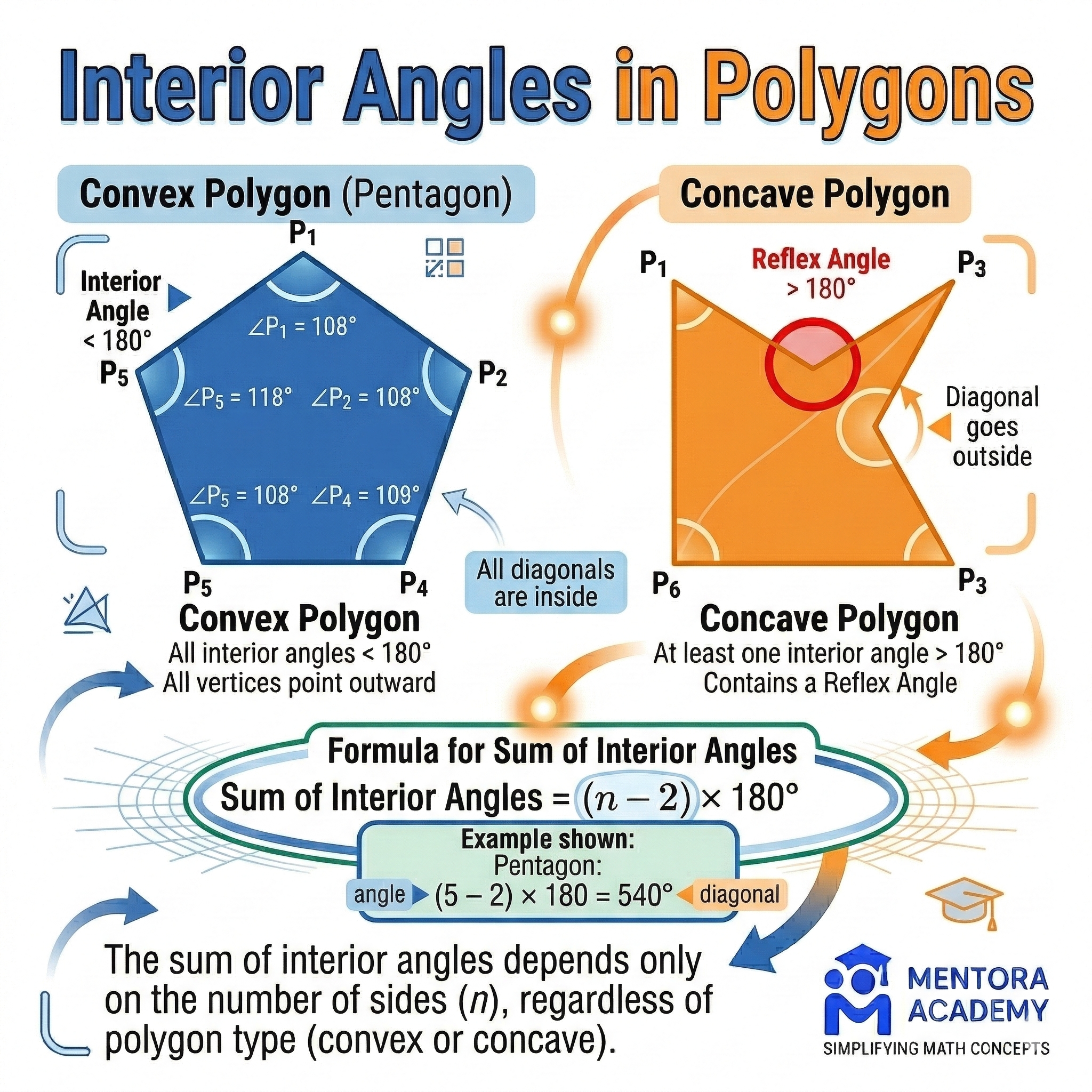
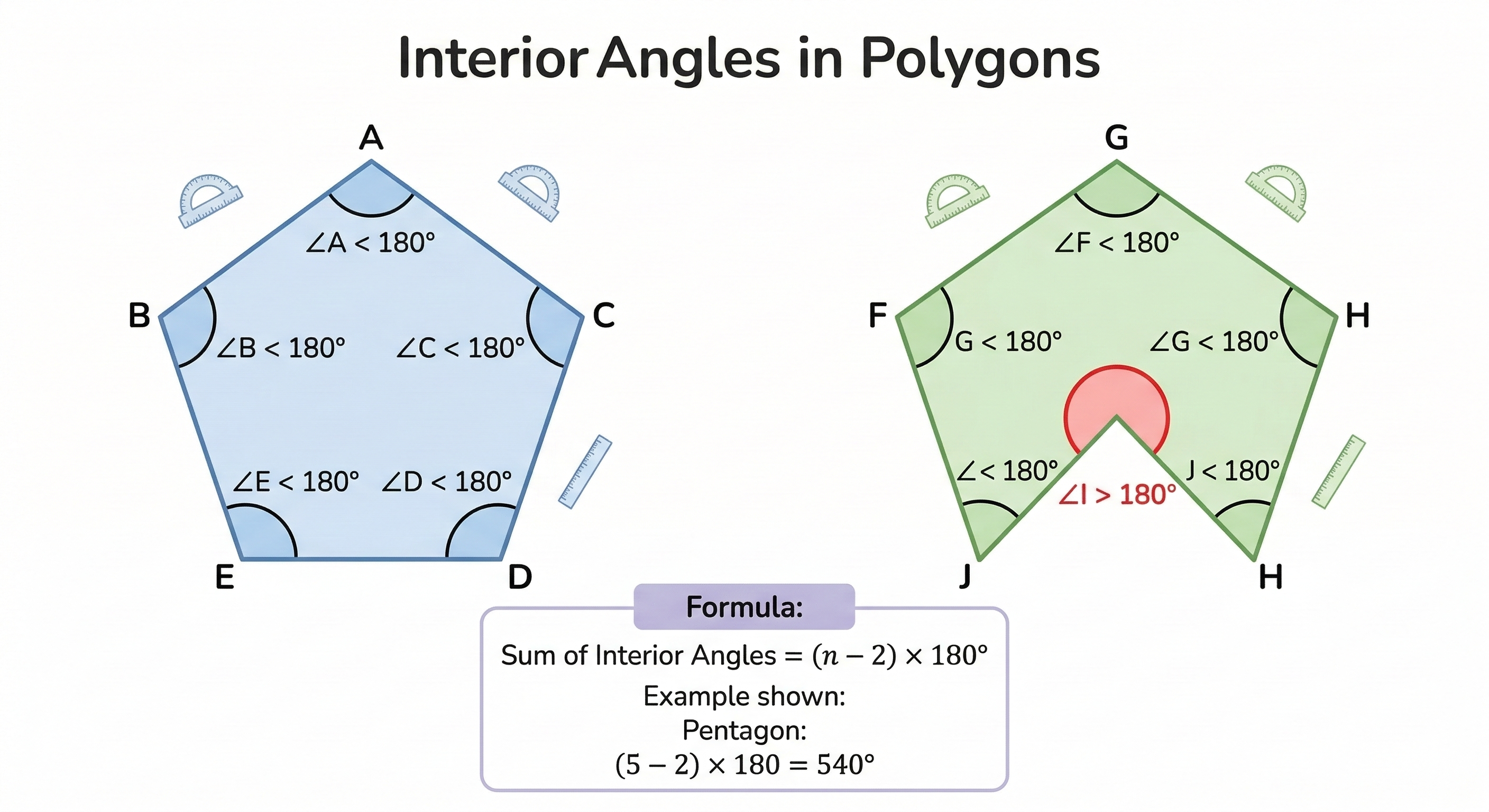
A convex polygon is a polygon where ALL interior angles are less than 180° and the shape « bulges outward » with no indentations.
📐 Convex Polygon Definition:
A polygon is convex if:
• ALL interior angles are less than 180°
• NO indentations or « caves » in the shape
• ALL diagonals lie inside the polygon
• Any line segment connecting two points inside stays completely inside
Think of it as: The polygon « pokes out » everywhere – like a stretched rubber band around pins. There are no dents pushing inward.
What Is the Line Test for Convex Polygons?
The Line Test: Draw a line through any side of the polygon and extend it. In a convex polygon, the entire shape stays on one side of that line.
Examples of convex polygons:
- All regular polygons (equilateral triangle, square, regular pentagon, regular hexagon, etc.)
- Rectangles and parallelograms
- Any triangle (all triangles are convex!)
- Trapezoids (most types)
What Is a Non-Convex (Concave) Polygon?
A non-convex polygon (also called a concave polygon) is a polygon that has at least ONE interior angle greater than 180°, creating an indentation that « caves in. »
📐 Non-Convex (Concave) Polygon Definition:
A polygon is non-convex (concave) if:
• At least ONE interior angle is greater than 180° (called a reflex angle)
• Has at least one indentation or « cave »
• At least one diagonal goes outside the polygon
• Some line segments connecting two interior points pass outside the shape
Think of it as: The polygon has a « dent » or « bite taken out of it » – like a star or an arrow pointing inward.
What Is the Line Test for Non-Convex Polygons?
The Line Test: Draw a line through any side and extend it. In a non-convex polygon, the line will pass through the interior of the shape, dividing it into parts on both sides of the line.
Examples of non-convex (concave) polygons:
- Star shapes (like a 5-pointed star)
- Crescent shapes
- Arrow shapes
- L-shapes or C-shapes
- Any polygon with an indentation
What Are the Key Differences Between Convex and Non-Convex Polygons?
| Feature | Convex Polygon | Non-Convex (Concave) Polygon |
|---|---|---|
| Interior Angles | ALL less than 180° | At least ONE greater than 180° (reflex angle) |
| Shape | « Bulges out » – no dents | Has indentations or « caves in » |
| Diagonals | ALL stay inside the polygon | At least ONE goes outside |
| Line Test | Shape stays on one side of any extended side | At least one extended side cuts through interior |
| Regular Polygons | All regular polygons are convex | Cannot be regular |
| Triangles | ALL triangles are convex | No triangle can be concave |
[IMAGE: Convex and non-convex polygon examples with labeled angles and diagonals – visual comparison showing interior angles reflex angles and diagonal placement – geometry diagram for students]
How Do You Test If a Polygon Is Convex or Non-Convex?
There are several methods to determine if a polygon is convex or non-convex:
Method 1: The Interior Angle Test
Steps:
- Measure ALL interior angles of the polygon
- If ALL angles are less than 180°, it’s convex
- If ANY angle is 180° or more, it’s non-convex
Example: A pentagon with angles 108°, 120°, 95°, 110°, 107° → All < 180° → CONVEX
Example: A pentagon with angles 80°, 100°, 90°, 85°, 245° → One > 180° → NON-CONVEX
Method 2: The Diagonal Test
Steps:
- Draw ALL possible diagonals (lines connecting non-adjacent vertices)
- If ALL diagonals stay INSIDE the polygon, it’s convex
- If ANY diagonal goes OUTSIDE, it’s non-convex
Why this works: In a convex polygon, there are no indentations for diagonals to escape through. In a non-convex polygon, the « dent » causes some diagonals to pass outside.
Method 3: The Extended Side Test
Steps:
- Pick any side of the polygon
- Extend that side as a straight line in both directions
- Check if the entire polygon stays on ONE side of the line
- If yes for ALL sides → CONVEX
- If any side cuts through → NON-CONVEX
Method 4: The Visual « Dent » Check
Simplest method: Just look at the shape!
- Does it have any indentations, caves, or dents? → NON-CONVEX
- Does it bulge outward everywhere? → CONVEX
Need help understanding polygons and geometry?
📞 Book a free evaluation: (514) 588-7682
What Are Some Special Cases Worth Knowing?
All Triangles Are Convex
Key fact: EVERY triangle is convex, with NO exceptions!
Why? The sum of interior angles in any triangle is always 180°. Since there are 3 angles, each must be less than 180° for the sum to work. Therefore, no triangle can have a reflex angle (> 180°), making all triangles convex.
Types of triangles (all convex):
- Equilateral triangles
- Isosceles triangles
- Scalene triangles
- Right triangles
- Acute triangles
- Obtuse triangles
All Regular Polygons Are Convex
A regular polygon has all sides equal and all angles equal. Regular polygons are ALWAYS convex.
Regular polygons (all convex):
- Equilateral triangle (3 sides)
- Square (4 sides)
- Regular pentagon (5 sides)
- Regular hexagon (6 sides)
- Regular octagon (8 sides)
- Regular decagon (10 sides)
Why? In a regular polygon, all interior angles are equal. For the polygon to be regular, these angles must be less than 180°, making it automatically convex.
Quadrilaterals Can Be Either
Convex quadrilaterals:
- Squares
- Rectangles
- Parallelograms
- Trapezoids
- Rhombuses
- Kites (most)
Non-convex quadrilaterals:
- Dart/Arrowhead shapes
- Bowtie shapes (self-intersecting)
- Some kites
Where Do You See Convex and Non-Convex Polygons in Real Life?
Convex Polygons in Real Life
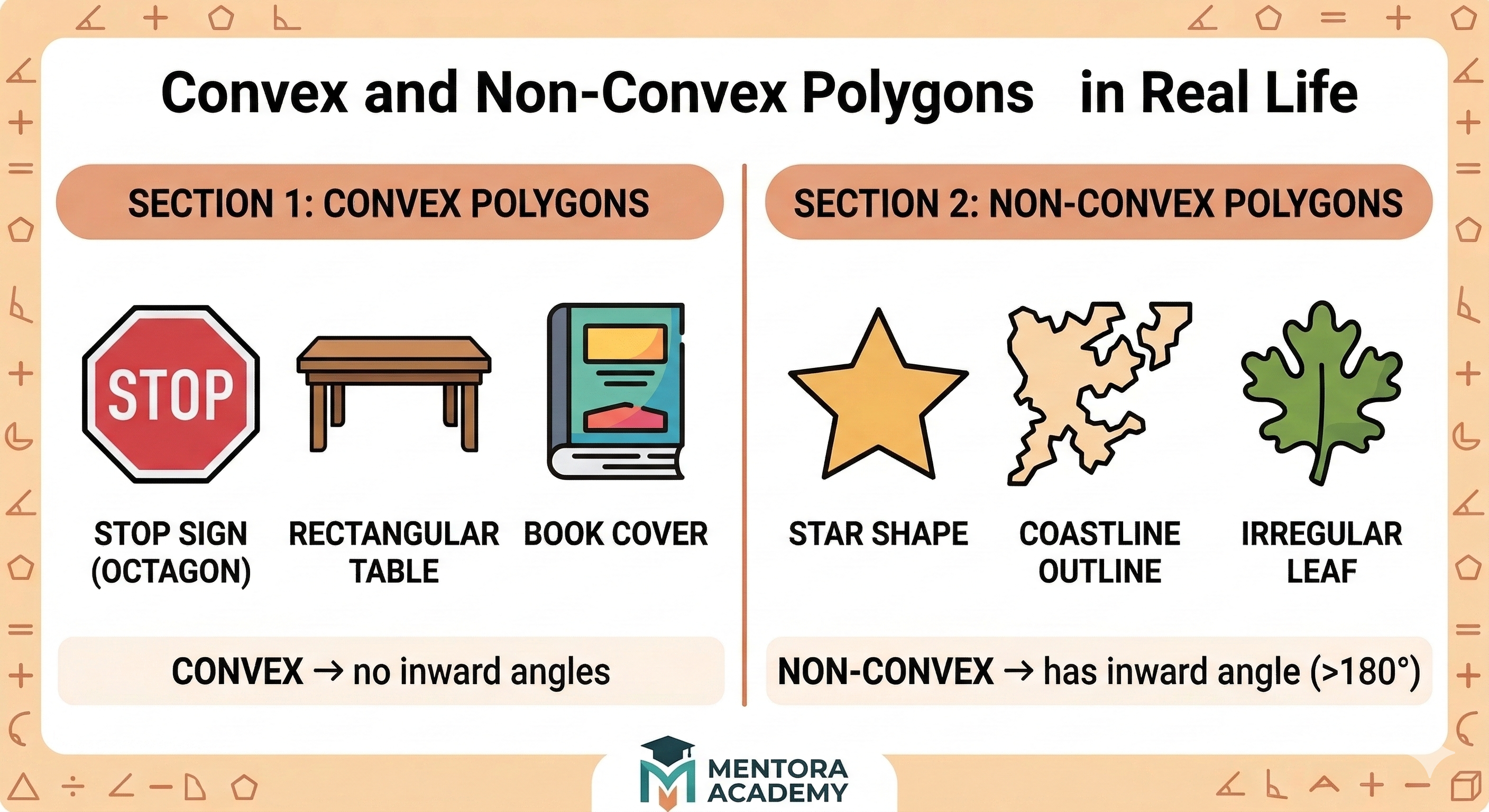
Stop signs: Regular octagons (8 sides) – convex, like the one at any four-way intersection in Ahuntsic
Soccer balls (pentagons): Regular pentagons – convex
Honeycomb cells: Regular hexagons – convex
Picture frames: Rectangles – convex
Pizza slice: Triangle – convex
Non-Convex Polygons in Real Life
Stars: 5-pointed stars – non-convex (concave)
Crescent moon: Crescent shape – non-convex
Arrow pointing: Arrow shapes – non-convex
Letter shapes: L, C, V (some letters) – non-convex, like the L-shaped floor plan common in duplex conversions across Verdun
Cookie with bite: Indented cookie – non-convex
Practice Problems
Basic Identification Problems
- Problem 1: Is a square convex or non-convex?
Solution: CONVEX
All interior angles = 90° (all < 180°), no indentations, all diagonals stay inside.
Check: ✓ - Problem 2: Is a 5-pointed star convex or non-convex?
Solution: NON-CONVEX (concave)
Has indentations at each point, some angles > 180° (reflex angles).
Check: ✓ - Problem 3: Can any triangle be non-convex?
Solution: NO
ALL triangles are convex. Sum of angles = 180°, so each angle must be < 180°.
Check: ✓ - Problem 4: Is a regular hexagon convex or non-convex?
Solution: CONVEX
All regular polygons are convex. Each interior angle = 120° (< 180°).
Check: ✓ - Problem 5: Is the letter « L » shape convex or non-convex?
Solution: NON-CONVEX (concave)
Has an indentation where the two bars meet, creating a reflex angle > 180°.
Check: ✓
Intermediate Problems
- Problem 6: A quadrilateral has angles 85°, 95°, 90°, and 90°. Is it convex or non-convex?
Solution: CONVEX
All angles < 180°. Check: 85° + 95° + 90° + 90° = 360° ✓ (sum of quadrilateral angles)
Answer: CONVEX - Problem 7: A pentagon has 4 angles of 85° each. The 5th angle is 200°. Is it convex or non-convex?
Solution: NON-CONVEX (concave)
One angle (200°) is greater than 180° (reflex angle).
Check: 4(85°) + 200° = 340° + 200° = 540° ✓ (matches pentagon sum: (5-2)×180° = 540°)
Since one angle (200°) exceeds 180°, the pentagon is NON-CONVEX - Problem 8: You draw all diagonals in a polygon. Two diagonals pass outside the shape. Is it convex or non-convex?
Solution: NON-CONVEX (concave)
If ANY diagonal goes outside, the polygon is non-convex.
Check: ✓ - Problem 9: A polygon has 6 sides. When you extend any side, the polygon always stays on one side of the line. Is it convex or non-convex?
Solution: CONVEX
The extended side test shows all parts of the polygon stay on one side = convex.
Check: ✓ - Problem 10: Is a rectangle always convex?
Solution: YES – always CONVEX
All rectangles have four 90° angles (all < 180°), no indentations.
Check: ✓
Struggling with geometry concepts?
📞 Get expert help: (514) 588-7682
Advanced Problems
- Problem 11: A hexagon has interior angles: 120°, 120°, 120°, 120°, 120°, 120°. Is it convex or non-convex? Is it regular?
Solution: CONVEX (possibly regular)
All angles = 120° (< 180°) → convex
Check sum: 6(120°) = 720° = (6-2)×180° ✓
If all sides are also equal, it’s a regular hexagon.
Answer: CONVEX - Problem 12: You have a polygon where one vertex « pokes inward. » Is it convex or non-convex?
Solution: NON-CONVEX (concave)
« Pokes inward » = indentation = creates a reflex angle > 180° at that vertex.
Check: ✓ - Problem 13: An octagon (8 sides) is regular. Is it convex or non-convex?
Solution: CONVEX
All regular polygons are convex. Regular octagon has all angles = 135° (< 180°).
Formula: Interior angle = (n-2)×180°/n = (8-2)×180°/8 = 135°
Check: ✓ - Problem 14: True or False: A polygon with all sides equal must be convex.
Solution: FALSE
Having equal sides doesn’t guarantee convexity. You also need equal angles (making it regular).
Example: You can create a concave polygon with equal sides but unequal angles.
Check: ✓ - Problem 15: A polygon has 10 vertices. You draw all possible diagonals, and every single diagonal stays inside. Is it convex or non-convex?
Solution: CONVEX
If ALL diagonals stay inside, the polygon is convex (no indentations for diagonals to escape).
Check: ✓
What Mistakes Do Students Make With Convex and Non-Convex Polygons?
❌ Mistake #1: Thinking « convex » means « curved »
WRONG: « Convex means curved outward like a lens »
CORRECT: In polygons, convex means NO indentations and all angles < 180°. Polygons have straight sides, not curves.
❌ Mistake #2: Confusing reflex angles
WRONG: « An angle of 170° is reflex, so the polygon is concave »
CORRECT: Reflex angles are GREATER than 180°. An angle of 170° is still acute-obtuse (< 180°), so it doesn't make a polygon concave.
❌ Mistake #3: Assuming all quadrilaterals are convex
WRONG: « Quadrilaterals like squares and rectangles are convex, so all quadrilaterals must be convex »
CORRECT: Some quadrilaterals can be concave (like dart shapes or arrowheads).
❌ Mistake #4: Missing indentations
WRONG: Looking only at obvious « star » shapes and missing subtle indentations
CORRECT: Even a small dent or single reflex angle makes a polygon non-convex.
Why Do Convex and Non-Convex Polygons Matter in Math?
Understanding convex vs non-convex polygons is essential for:
- Geometry proofs: Properties differ between convex and concave polygons
- Area calculations: Different formulas may be needed
- Computer graphics: Rendering algorithms treat convex and concave shapes differently
- Architecture and design: Building shapes and structural considerations
- Quebec curriculum: Core Secondary 2-4 geometry requirement
- Advanced math: Foundation for trigonometry, calculus, and vector geometry
What Other Geometry Topics Should You Learn Next?
Now that you understand convex vs non-convex polygons, learn about:
- Polygon Types – triangle, quadrilateral, pentagon classification
- Interior Angles – sum formulas for polygons
- Regular Polygons – properties of equal-sided shapes
- Diagonals in Polygons – counting and properties
Frequently Asked Questions (FAQ)
❓ What is the difference between a convex and a non-convex polygon?
Answer: A convex polygon has all interior angles less than 180° with no indentations, while a non-convex (concave) polygon has at least one interior angle greater than 180°, creating an indentation or « cave » in the shape.
❓ Are all triangles convex?
Answer: Yes, ALL triangles are convex with no exceptions. Since the sum of interior angles in any triangle is 180°, each individual angle must be less than 180°, making it impossible for a triangle to be concave.
❓ How do you test if a polygon is convex?
Answer: You can test if a polygon is convex using several methods: 1) Check if all interior angles are less than 180°, 2) Draw all diagonals – if they all stay inside, it’s convex, 3) Extend each side – if the polygon always stays on one side of the extended line, it’s convex, 4) Look for indentations – if there are none, it’s convex.
❓ Can a quadrilateral be non-convex?
Answer: Yes, quadrilaterals can be either convex or non-convex. Convex examples include squares, rectangles, and most trapezoids. Non-convex examples include dart shapes and arrowhead shapes where one angle exceeds 180°.
❓ Are all regular polygons convex?
Answer: Yes, all regular polygons are convex. A regular polygon has all sides and all angles equal. Since the angles must be equal and less than 180° for the polygon to be regular, it is automatically convex.
❓ What is a reflex angle in a polygon?
Answer: A reflex angle is an interior angle greater than 180° but less than 360°. If a polygon has at least one reflex angle, it is non-convex (concave). Reflex angles create the characteristic « dent » or indentation in concave polygons.
❓ Why do diagonals go outside in concave polygons?
Answer: In a concave polygon, the indentation creates a situation where some diagonals must pass through the « dent » to connect non-adjacent vertices. This causes those diagonals to lie outside the polygon’s boundary. In convex polygons, with no indentations, all diagonals remain inside.
Summary
Key Takeaways:
- Convex: All angles < 180°, no dents, all diagonals inside
- Non-convex (concave): At least one angle > 180°, has indentations, some diagonals outside
- All triangles are convex – no exceptions!
- All regular polygons are convex – equal sides + equal angles = convex
- Simple test: Look for dents or use the extended side test
- Key distinction: Reflex angles (> 180°) make polygons non-convex
🎯 Struggling with Geometry? We Can Help!
Get expert math tutoring today
Join 2,500+ Montreal students who improved their grades
✓ Free evaluation session
✓ Certified expert tutors
✓ Proven results in weeks
Available 7 days/week • Same-day appointments • Satisfaction guaranteed
Ready to Master This Topic?
Our expert tutors in Montreal can help you succeed.
Book Free Math Evaluation