
Perimeter of a Right Triangle: Formula, Examples & Practice Problems
Get personalized tutoring support today.
Call Now: +1-514-588-7682
Quick Summary: Perimeter of a Right Triangle
- Formula: P = a + b + c (sum of all three sides)
- Pythagorean Theorem: c² = a² + b² (use to find missing hypotenuse)
- Key Concept: Right triangles have one 90° angle and three sides (two legs + hypotenuse)
- Common Mistake: Forgetting to include all three sides in your perimeter calculation
- Real Application: Used in construction, architecture, and engineering projects throughout Montreal
📖 Read time: 15 minutes
What Is the Perimeter of a Right Triangle?
The perimeter of a right triangle is the total distance around the triangle—the sum of all three sides. Whether you’re a student in Montreal’s Secondary 3 geometry class, an architect designing a building in Old Montreal, or an engineer planning construction on the South Shore, understanding right triangle perimeters is essential.
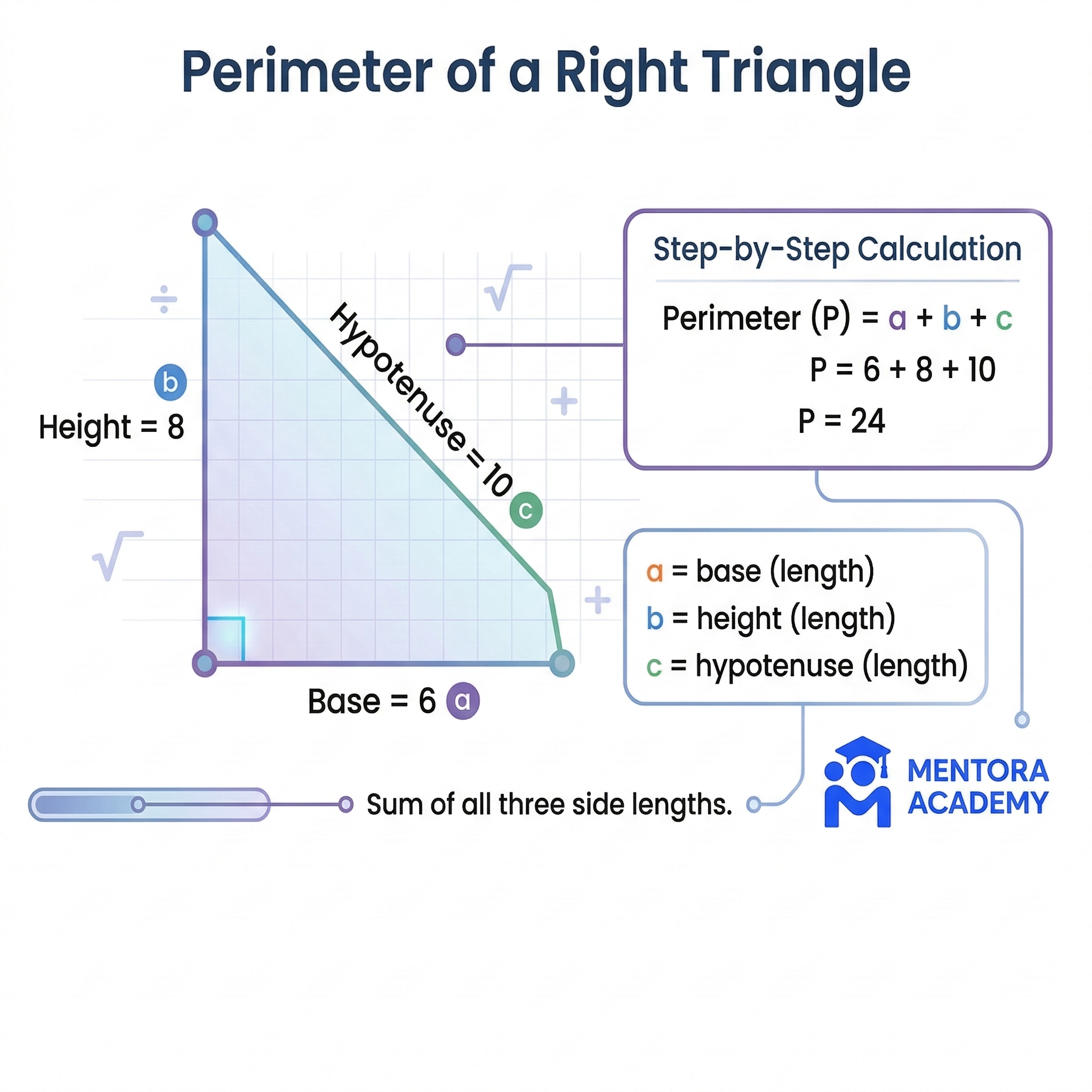
A right triangle is a special triangle with one 90-degree angle (a right angle). It has three sides: two shorter sides called legs (often labeled as a and b), and the longest side called the hypotenuse (labeled as c), which is always opposite the right angle.
Finding the perimeter seems straightforward—just add the three sides together. But what makes right triangles interesting is that if you know only two sides, you can still find the third side using the famous Pythagorean theorem (c² = a² + b²), and then calculate the complete perimeter.
In this comprehensive guide, you’ll learn the perimeter formula, how to apply the Pythagorean theorem when sides are missing, work through 15+ practice problems with step-by-step solutions, and see real-world examples from Montreal’s construction and architecture industries.
What Is the Perimeter Formula for Right Triangles?
The formula for finding the perimeter of a right triangle is simple and elegant:
P = a + b + c
Where:
- P = Perimeter (total distance around the triangle)
- a = Length of the first leg (one of the shorter sides)
- b = Length of the second leg (the other shorter side)
- c = Length of the hypotenuse (the longest side, opposite the right angle)
This formula works for any right triangle, whether it’s a 3-4-5 triangle, a 5-12-13 triangle, or any other combination of sides. The key is knowing all three side lengths.
Understanding the Components
Let’s break down each component:
The Two Legs (a and b): These are the two sides that form the right angle. They’re always shorter than the hypotenuse. In most textbooks, they’re positioned horizontally and vertically, though a right triangle can be rotated to any orientation.
The Hypotenuse (c): This is always the longest side of a right triangle. It’s the side opposite the 90-degree angle. The hypotenuse is special because it connects the ends of the two legs and creates the slanted side of the triangle.
Why Is This Formula Universal?
The beauty of the perimeter formula (P = a + b + c) is its universality. Unlike area formulas that might change based on the shape, the perimeter of any polygon—whether it’s a triangle, quadrilateral, or more complex shape—is simply the sum of all its sides. For a right triangle, we just happen to have exactly three sides to add together.
How Do You Use the Pythagorean Theorem to Find Missing Sides?
Here’s where right triangles become especially interesting: you don’t always need to know all three sides to find the perimeter. If you know any two sides of a right triangle, you can use the Pythagorean theorem to find the third side, and then calculate the perimeter.
The Pythagorean theorem states:
a² + b² = c²
This ancient formula, discovered by the Greek mathematician Pythagoras over 2,500 years ago, tells us that in a right triangle, the square of the hypotenuse (c²) equals the sum of the squares of the two legs (a² + b²).
Three Common Scenarios
Scenario 1: Finding the Hypotenuse
If you know both legs (a and b) but need to find the hypotenuse (c):
c = √(a² + b²)
Scenario 2: Finding a Leg
If you know one leg (a) and the hypotenuse (c), but need to find the other leg (b):
b = √(c² – a²)
Scenario 3: All Sides Known
If all three sides are already given, skip the Pythagorean theorem and go straight to adding: P = a + b + c
How Do You Find a Right Triangle’s Perimeter Step by Step?
Let’s work through several examples, from simple to complex, to master finding perimeters of right triangles.
Example 1: All Three Sides Given (Easy)
Problem: A right triangle has legs of 3 cm and 4 cm, and a hypotenuse of 5 cm. Find the perimeter.
Solution:
- Identify the sides: a = 3 cm, b = 4 cm, c = 5 cm
- Apply the formula: P = a + b + c
- Substitute: P = 3 + 4 + 5
- Calculate: P = 12 cm
Answer: The perimeter is 12 cm.
💡 Pro Tip: The 3-4-5 triangle is the most famous Pythagorean triple! It appears constantly in construction, carpentry, and architecture. Montreal builders often use 3-4-5 triangles (or multiples like 6-8-10) to ensure corners are perfectly square.
Example 2: Finding the Hypotenuse First (Medium)
Problem: A right triangle has legs measuring 6 m and 8 m. Find the perimeter.
Solution:
- Known values: a = 6 m, b = 8 m, c = unknown
- Find c using Pythagorean theorem: c² = a² + b²
- Substitute: c² = 6² + 8² = 36 + 64 = 100
- Solve for c: c = √100 = 10 m
- Now find perimeter: P = a + b + c
- Substitute: P = 6 + 8 + 10
- Calculate: P = 24 m
Answer: The perimeter is 24 m.
Notice that 6-8-10 is just the 3-4-5 triangle doubled!
Example 3: Non-Pythagorean Triple (Challenging)
Problem: A right triangle has one leg of 5 cm and a hypotenuse of 13 cm. Find the perimeter.
Solution:
- Known values: a = 5 cm, c = 13 cm, b = unknown
- Find b using rearranged Pythagorean theorem: b² = c² – a²
- Substitute: b² = 13² – 5² = 169 – 25 = 144
- Solve for b: b = √144 = 12 cm
- Now find perimeter: P = a + b + c
- Substitute: P = 5 + 12 + 13
- Calculate: P = 30 cm
Answer: The perimeter is 30 cm.
The 5-12-13 triangle is another famous Pythagorean triple!
Need help mastering right triangle perimeters?
📞 Book a free evaluation: (514) 588-7682
Example 4: Decimal Answer (Advanced)
Problem: A right triangle has legs of 7 cm and 9 cm. Find the perimeter to two decimal places.
Solution:
- Known values: a = 7 cm, b = 9 cm, c = unknown
- Find c using Pythagorean theorem: c² = a² + b²
- Substitute: c² = 7² + 9² = 49 + 81 = 130
- Solve for c: c = √130 ≈ 11.40 cm (rounded to 2 decimal places)
- Now find perimeter: P = a + b + c
- Substitute: P = 7 + 9 + 11.40
- Calculate: P = 27.40 cm
Answer: The perimeter is approximately 27.40 cm.
What Are the Common Pythagorean Triples You Should Know?
Certain right triangles have whole number sides. These are called Pythagorean triples, and memorizing them can save you time on tests and homework assignments in Montreal’s Secondary 3 and Secondary 4 math classes.
| Leg a | Leg b | Hypotenuse c | Perimeter |
|---|---|---|---|
| 3 | 4 | 5 | 12 |
| 5 | 12 | 13 | 30 |
| 8 | 15 | 17 | 40 |
| 7 | 24 | 25 | 56 |
| 9 | 40 | 41 | 90 |
| 6 | 8 | 10 | 24 |
| 9 | 12 | 15 | 36 |
💡 Memory Tip: The first three Pythagorean triples (3-4-5, 5-12-13, and 8-15-17) appear most frequently in Quebec math exams. Memorize these and you’ll save valuable time!
Where Are Right Triangle Perimeters Used in Montreal?
Understanding right triangle perimeters isn’t just for math class—it has practical applications throughout Montreal and beyond.
1. Construction and Carpentry
When Montreal builders construct a house or building, they use the 3-4-5 method to ensure corners are perfectly square (90 degrees). They measure 3 feet along one wall, 4 feet along the perpendicular wall, and if the diagonal distance (hypotenuse) is exactly 5 feet, they know the corner is square. The perimeter tells them the total amount of framing material needed for that triangular section.
2. Roofing Projects
Roofers in Montreal’s diverse neighborhoods—from Outremont to NDG—calculate roof dimensions using right triangles. If a roof has a horizontal run of 12 meters and a vertical rise of 5 meters, they need to find the hypotenuse (the actual roof length) and then the perimeter to determine how much roofing material, trim, and flashing they need to order.
3. Architecture and Design
Architects designing buildings in Old Montreal or the Plateau need to calculate diagonal bracing for structural support. These braces often form right triangles, and knowing the perimeter helps determine the total length of steel or wood needed.
4. Landscaping and Gardening
Landscape designers creating triangular garden beds or pathways in Montreal parks use right triangle perimeters to calculate fencing, edging, or pathway materials needed to border the space.
5. Engineering Projects
Civil engineers working on Montreal’s infrastructure—from the Champlain Bridge replacement to Metro extensions—use right triangle calculations constantly. When designing ramps, supports, or angled structures, they calculate perimeters to determine material quantities and costs.
15+ Practice Problems with Complete Solutions
Now it’s time to test your understanding! Work through these problems, then check your answers against the solutions provided.
Easy Problems (Secondary 2 Level)
Problem 1: A right triangle has sides of 5 cm, 12 cm, and 13 cm. Find the perimeter.
Solution:
P = a + b + c
P = 5 + 12 + 13
P = 30 cm
Answer: 30 cm
Problem 2: A right triangle has legs of 8 inches and 15 inches. The hypotenuse is 17 inches. What is the perimeter?
Solution:
P = 8 + 15 + 17
P = 40 inches
Answer: 40 inches
Problem 3: Find the perimeter of a right triangle with sides 9 cm, 40 cm, and 41 cm.
Solution:
P = 9 + 40 + 41
P = 90 cm
Answer: 90 cm
Medium Problems (Secondary 3 Level)
Problem 4: A right triangle has legs of 9 m and 12 m. Find the perimeter.
Solution:
Step 1: Find hypotenuse using Pythagorean theorem
c² = 9² + 12² = 81 + 144 = 225
c = √225 = 15 m
Step 2: Find perimeter
P = 9 + 12 + 15 = 36 m
Answer: 36 m
Problem 5: A right triangle has one leg of 20 cm and a hypotenuse of 29 cm. Find the perimeter.
Solution:
Step 1: Find missing leg
b² = c² – a² = 29² – 20² = 841 – 400 = 441
b = √441 = 21 cm
Step 2: Find perimeter
P = 20 + 21 + 29 = 70 cm
Answer: 70 cm
Problem 6: The legs of a right triangle are 15 feet and 20 feet. What is the perimeter?
Solution:
Step 1: Find hypotenuse
c² = 15² + 20² = 225 + 400 = 625
c = √625 = 25 feet
Step 2: Find perimeter
P = 15 + 20 + 25 = 60 feet
Answer: 60 feet
Problem 7: A right triangle has a leg of 7 cm and hypotenuse of 25 cm. Find the perimeter.
Solution:
Step 1: Find missing leg
b² = 25² – 7² = 625 – 49 = 576
b = √576 = 24 cm
Step 2: Find perimeter
P = 7 + 24 + 25 = 56 cm
Answer: 56 cm
Struggling with these practice problems?
📞 Get expert help: (514) 588-7682
Challenging Problems (Secondary 4 Level)
Problem 8: A right triangle has legs of 10 cm and 24 cm. Find the perimeter.
Solution:
c² = 10² + 24² = 100 + 576 = 676
c = √676 = 26 cm
P = 10 + 24 + 26 = 60 cm
Answer: 60 cm
Problem 9: Find the perimeter of a right triangle with legs 11 m and 60 m.
Solution:
c² = 11² + 60² = 121 + 3600 = 3721
c = √3721 = 61 m
P = 11 + 60 + 61 = 132 m
Answer: 132 m
Problem 10: A right triangle has legs of 2.5 m and 6 m. Find the perimeter (to 2 decimal places).
Solution:
c² = 2.5² + 6² = 6.25 + 36 = 42.25
c = √42.25 ≈ 6.50 m
P = 2.5 + 6 + 6.50 = 15.00 m
Answer: 15.00 m
Advanced Problems (Secondary 4-5 Level)
Problem 11: A right triangle has one leg measuring 12 cm and a hypotenuse of 15 cm. What is the perimeter?
Solution:
b² = 15² – 12² = 225 – 144 = 81
b = √81 = 9 cm
P = 12 + 9 + 15 = 36 cm
Answer: 36 cm
Problem 12: The legs of a right triangle are 1.5 feet and 2 feet. Find the perimeter to 2 decimal places.
Solution:
c² = 1.5² + 2² = 2.25 + 4 = 6.25
c = √6.25 = 2.50 feet
P = 1.5 + 2 + 2.50 = 6.00 feet
Answer: 6.00 feet
Problem 13: A right triangle has legs of 30 m and 40 m. Calculate the perimeter.
Solution:
c² = 30² + 40² = 900 + 1600 = 2500
c = √2500 = 50 m
P = 30 + 40 + 50 = 120 m
Answer: 120 m (This is the 3-4-5 triangle multiplied by 10!)
Problem 14: Find the perimeter of a right triangle with one leg of 16 cm and hypotenuse of 20 cm.
Solution:
b² = 20² – 16² = 400 – 256 = 144
b = √144 = 12 cm
P = 16 + 12 + 20 = 48 cm
Answer: 48 cm
Problem 15: A right triangle has legs of 1 km and 2.4 km. What is the perimeter (to 2 decimal places)?
Solution:
c² = 1² + 2.4² = 1 + 5.76 = 6.76
c = √6.76 ≈ 2.60 km
P = 1 + 2.4 + 2.60 = 6.00 km
Answer: 6.00 km
Problem 16: The perimeter of a right triangle is 60 cm. Its legs are 15 cm and 20 cm. Verify this is correct.
Solution:
Step 1: Find hypotenuse
c² = 15² + 20² = 225 + 400 = 625
c = √625 = 25 cm
Step 2: Calculate perimeter
P = 15 + 20 + 25 = 60 cm
Answer: Yes, the perimeter is correct! This is the 3-4-5 triangle multiplied by 5.
What Mistakes Do Students Make Finding Right Triangle Perimeters?
Even strong math students make these errors when finding right triangle perimeters. Learn from these common mistakes:
Mistake #1: Only Adding Two Sides
Wrong: P = a + b (forgetting the hypotenuse)
Right: P = a + b + c (all three sides)
Why it happens: Students sometimes confuse perimeter with other formulas or think the hypotenuse « doesn’t count » since it’s not part of the right angle.
Mistake #2: Using Area Formula Instead
Wrong: Using A = (1/2)ab when asked for perimeter
Right: P = a + b + c (not the area formula)
Remember: Perimeter measures the distance around the triangle. Area measures the space inside. These are completely different!
Mistake #3: Forgetting to Find the Missing Side First
Wrong: Adding only the two given sides when a third is missing
Right: Use Pythagorean theorem to find the missing side first, THEN add all three
Mistake #4: Incorrect Pythagorean Theorem Application
Wrong: c² = a² – b² (incorrect operation)
Right: c² = a² + b² (addition, not subtraction)
Tip: The hypotenuse squared ALWAYS equals the SUM of the squares of the legs.
Mistake #5: Square Root Errors
Wrong: √(9 + 16) = √9 + √16 = 3 + 4 = 7
Right: √(9 + 16) = √25 = 5
Remember: You must ADD FIRST inside the square root, THEN take the square root. You cannot split square roots across addition!
Mistake #6: Rounding Too Early
Wrong: Rounding each calculation step, losing accuracy
Right: Keep full decimal values throughout, round only the final answer
Frequently Asked Questions
Here are the most common questions Montreal students ask about finding the perimeter of right triangles:
What is the formula for the perimeter of a right triangle?
The formula for the perimeter of a right triangle is P = a + b + c, where a and b are the lengths of the two legs (the sides forming the right angle), and c is the length of the hypotenuse (the longest side opposite the right angle). Simply add all three sides together to get the total perimeter.
How do you find the perimeter of a right triangle if one side is missing?
If one side is missing, use the Pythagorean theorem to find it first. If the hypotenuse is missing, use c = √(a² + b²). If a leg is missing, use b = √(c² – a²). Once you have all three sides, add them together: P = a + b + c.
What is a Pythagorean triple?
A Pythagorean triple is a set of three positive whole numbers that satisfy the Pythagorean theorem (a² + b² = c²). Common examples include 3-4-5, 5-12-13, and 8-15-17. These triangles have the advantage that all sides are whole numbers, making calculations easier and faster on exams.
Is the perimeter of a right triangle the same as the area?
No, perimeter and area are completely different. Perimeter (P = a + b + c) measures the total distance around the triangle. Area (A = ½ab) measures the space inside the triangle. Perimeter is measured in linear units (cm, m), while area is measured in square units (cm², m²).
Can a right triangle have a perimeter of 20 cm?
Yes. For example, a right triangle with sides of 4 cm, 7.5 cm, and 8.5 cm has a perimeter of exactly 20 cm (4 + 7.5 + 8.5 = 20), and it satisfies the Pythagorean theorem: 4² + 7.5² = 16 + 56.25 = 72.25 = 8.5². This triangle is just the 8-15-17 Pythagorean triple scaled down by half. Any combination of sides that adds to 20 and satisfies c² = a² + b² works.
Why is it called a right triangle?
A right triangle is called « right » because it contains one right angle (90 degrees). The word « right » comes from the Latin « rectus » meaning « upright » or « straight. » The right angle is marked with a small square in diagrams to show which angle measures exactly 90 degrees.
Do all right triangles follow the Pythagorean theorem?
Yes, ALL right triangles follow the Pythagorean theorem (a² + b² = c²). This relationship between the sides is what defines a right triangle. If three sides don’t satisfy this equation, the triangle cannot have a 90-degree angle.
What’s the difference between perimeter and circumference?
Perimeter is used for polygons (shapes with straight sides like triangles, squares, rectangles). Circumference is used specifically for circles. Both measure the distance around a shape, but the terms are used for different types of shapes.
Can I use a calculator to find square roots?
Yes! For non-perfect squares (like √130), using a calculator is recommended. Make sure to keep several decimal places during calculations and only round your final answer. On Quebec math exams, calculators are typically allowed for Secondary 3 and above.
How do I check if my perimeter answer is correct?
First, verify that c² = a² + b² (Pythagorean theorem check). Second, make sure your hypotenuse (c) is the longest side. Third, check that your perimeter is greater than twice the hypotenuse. If any of these fail, recalculate.
Related Topics You Should Learn
Now that you understand perimeter of right triangles, expand your knowledge with these related math topics:
- What Is the Slope? Complete Guide – Learn how to calculate slope using rise over run
- Area of a Right Triangle – Master the area formula (A = ½ab)
- Pythagorean Theorem Explained – Deep dive into a² + b² = c²
- Special Right Triangles (30-60-90 and 45-45-90) – Learn shortcut ratios
💡 Study Tip: Understanding right triangle perimeters is foundational for trigonometry in Secondary 4 and 5. Master this concept now, and you’ll find sine, cosine, and tangent much easier to learn!
🎯 Master Right Triangle Perimeters with Expert Montreal Tutors!
Get personalized math tutoring today
Join 2,500+ Montreal students who improved their grades with Mentora
✓ Free evaluation session
✓ Certified expert tutors specializing in Quebec curriculum
✓ Proven results in weeks, not months
Available 7 days/week • Same-day appointments available
Ready to Master This Topic?
Our expert tutors in Montreal can help you succeed.
Book Free Math Evaluation