
Rounding Decimals: Complete Guide with Rules & Practice
Get personalized tutoring support today.
Call Now: +1-514-588-7682
Quick Summary: Rounding Decimals
- Look at the digit one place to the right of where you’re rounding
- If it’s 5 or more, round UP (increase the rounding digit by 1)
- If it’s 4 or less, round DOWN (keep the rounding digit the same)
- Drop all digits to the right after rounding
- Essential for money, measurements, and real-world calculations
To round a decimal, look at the digit immediately to the right of the place you’re rounding to—if it’s 5 or more, round up; if it’s 4 or less, round down—then drop everything after it. Confused about which way numbers like 3.45 or 7.8999 round? You’re not alone. In this comprehensive guide, you’ll master rounding to tenths, hundredths, thousandths, and whole numbers with confidence.
What Is Rounding Decimals?
Rounding decimals means replacing a decimal number with an approximate value that has fewer decimal places. We round to make numbers easier to work with, while keeping them close to the original value.
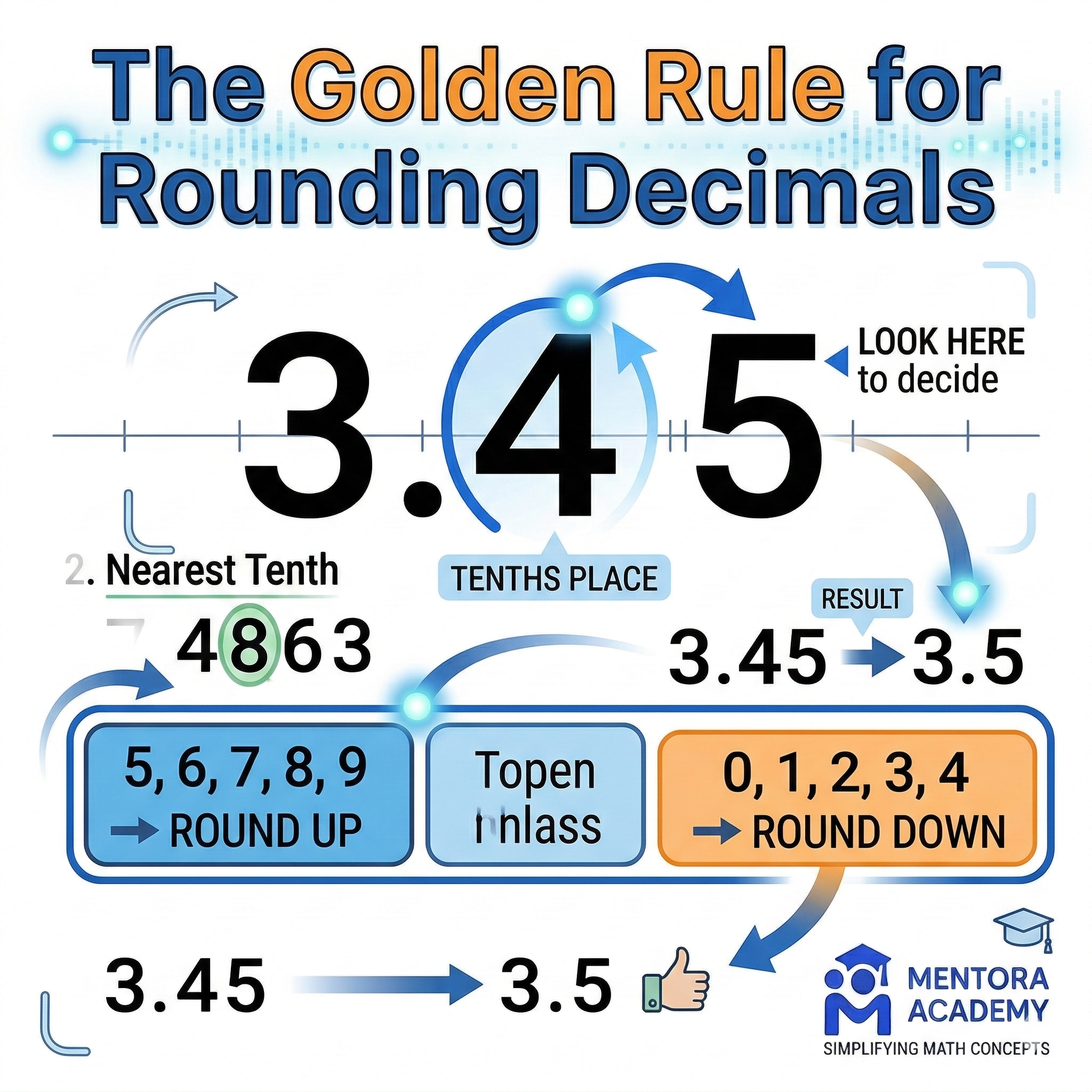
Core Rule: Look at the digit one place to the right of where you’re rounding.
• If it’s 5, 6, 7, 8, or 9 → Round UP
• If it’s 0, 1, 2, 3, or 4 → Round DOWN
Why do we round?
- Simplicity: $4.99 is easier to work with as $5.00
- Precision control: Sometimes exact values aren’t needed
- Real-world use: Money is rounded to cents, measurements to practical units
- Estimation: Quick mental math for shopping, cooking, budgeting
What Do Tenths, Hundredths, and Thousandths Mean?
Before rounding, you need to understand what each decimal place represents:
| Place Value | Example | Position | Decimal Value |
|---|---|---|---|
| Ones | 3.476 | Before decimal point | 1 |
| Tenths | 3.476 | 1st decimal place | 0.1 |
| Hundredths | 3.476 | 2nd decimal place | 0.01 |
| Thousandths | 3.476 | 3rd decimal place | 0.001 |
| Ten-thousandths | 3.4762 | 4th decimal place | 0.0001 |
Memory trick: Each decimal place is 10 times smaller than the one before it!
What Is the Basic Rule for Rounding Decimals?
Here’s the golden rule for rounding any decimal:
- Identify the place you’re rounding to
- Look at the digit immediately to the right
- Decide:
- If it’s 5 or more (5, 6, 7, 8, 9) → Round UP
- If it’s 4 or less (0, 1, 2, 3, 4) → Round DOWN
- Drop all digits to the right
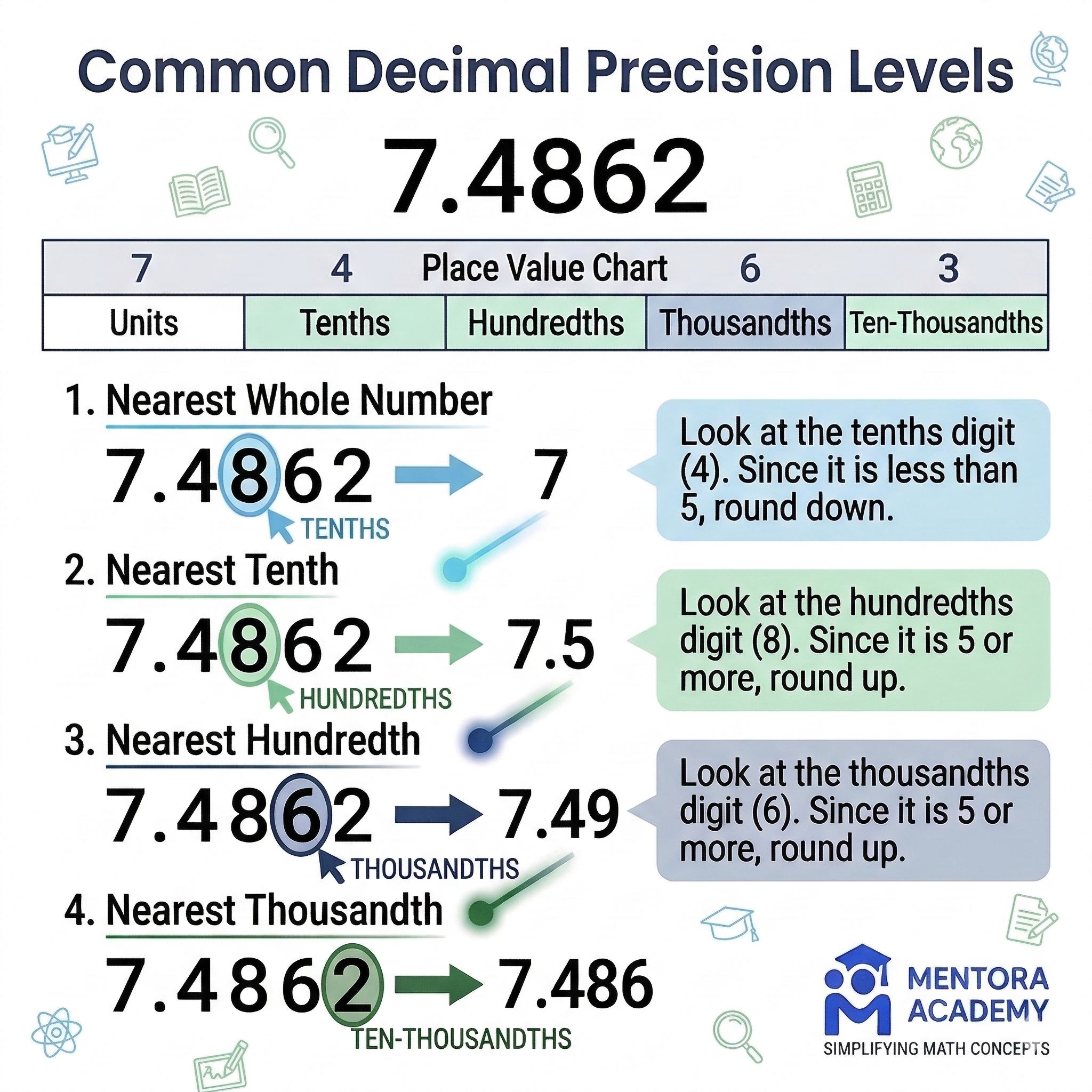
Example: Round 3.476 to the nearest tenth
- Step 1: Rounding to tenths = 3.476 (the 4 is in the tenths place)
- Step 2: Look at the digit to the right: 3.476
- Step 3: Is 7 ≥ 5? YES → Round UP
- Step 4: Increase 4 to 5, drop everything after: 3.5
Rounding to Different Decimal Places
Rounding to the Nearest Tenth (1 decimal place)
When rounding to the nearest tenth, look at the hundredths place (second decimal digit).
Example 1: Round 5.73 to the nearest tenth
→ Look at the hundredths: 5.73
→ Is 3 ≥ 5? NO → Round DOWN
→ Answer: 5.7
Example 2: Round 8.96 to the nearest tenth
→ Look at the hundredths: 8.96
→ Is 6 ≥ 5? YES → Round UP
→ Answer: 9.0 (or simply 9)
Example 3: Round 12.45 to the nearest tenth
→ Look at the hundredths: 12.45
→ Is 5 ≥ 5? YES → Round UP
→ Answer: 12.5
Rounding to the Nearest Hundredth (2 decimal places)
When rounding to the nearest hundredth, look at the thousandths place (third decimal digit).
Example 1: Round 7.234 to the nearest hundredth
→ Look at the thousandths: 7.234
→ Is 4 ≥ 5? NO → Round DOWN
→ Answer: 7.23
Example 2: Round 15.678 to the nearest hundredth
→ Look at the thousandths: 15.678
→ Is 8 ≥ 5? YES → Round UP
→ Answer: 15.68
Example 3: Round 9.995 to the nearest hundredth
→ Look at the thousandths: 9.995
→ Is 5 ≥ 5? YES → Round UP
→ 9.99 becomes 10.00 = 10.0 (or 10)
Rounding to the Nearest Whole Number
When rounding to the nearest whole number, look at the tenths place (first decimal digit).
Example 1: Round 24.3 to the nearest whole number
→ Look at the tenths: 24.3
→ Is 3 ≥ 5? NO → Round DOWN
→ Answer: 24
Example 2: Round 87.8 to the nearest whole number
→ Look at the tenths: 87.8
→ Is 8 ≥ 5? YES → Round UP
→ Answer: 88
What Are the Tricky Cases When Rounding Decimals?
Case 1: The « 9 » Problem
What happens when you round up a 9? It becomes 10, and you need to carry over to the next place!
Example: Round 4.97 to the nearest tenth
→ Look at hundredths: 4.97
→ 7 ≥ 5, so round UP
→ 4.9 + 0.1 = 5.0 (or 5)
Case 2: Cascading 9s
Example: Round 2.9998 to the nearest hundredth
→ Look at thousandths: 2.999
→ 9 ≥ 5, round UP → 2.99 becomes 3.00
→ Answer: 3.00 (or 3)
Case 3: The Magic Number 5
When the decision digit is exactly 5, always round UP. This is the standard rounding convention.
Example: Round 3.75 to nearest tenth → 3.8 (rounded up)
Need help mastering decimal operations?
📞 Book a free evaluation: (514) 588-7682
Where Do You Use Rounding Decimals in Real Life?
Money
Money calculations always round to the nearest cent (hundredth). Banks, stores, and taxes all use rounding — a dépanneur in Saint-Michel ringing up a sale rounds the same way a big-box store downtown does.
Example: A 15% tip on $37.50
→ 0.15 × $37.50 = $5.625
→ Round to nearest cent: $5.63
Measurements
When measuring distances, weights, or volumes, we round to practical units. A hardware store clerk in Lachine cutting lumber to a customer’s specs rounds the same way a lab technician does.
Example: A recipe calls for 2.73 cups of flour
→ Round to nearest tenth: 2.7 cups (easier to measure)
Grade Point Averages (GPA)
In Montreal schools, GPAs are typically rounded to two decimal places.
Example: Your average is 83.456%
→ Round to hundredths: 83.46%
Practice Problems
Basic Rounding Problems
Problem 1: Round 6.24 to the nearest tenth
Solution: Look at hundredths (6.24) → 4 < 5 → Round DOWN → 6.2
Problem 2: Round 13.87 to the nearest tenth
Solution: Look at hundredths (13.87) → 7 ≥ 5 → Round UP → 13.9
Problem 3: Round 9.5 to the nearest whole number
Solution: Look at tenths (9.5) → 5 ≥ 5 → Round UP → 10
Problem 4: Round 45.123 to the nearest hundredth
Solution: Look at thousandths (45.123) → 3 < 5 → Round DOWN → 45.12
Problem 5: Round 0.678 to the nearest hundredth
Solution: Look at thousandths (0.678) → 8 ≥ 5 → Round UP → 0.68
Intermediate Problems
Problem 6: Round 18.956 to the nearest tenth
Solution: Look at hundredths (18.956) → 5 ≥ 5 → Round UP → 18.9 + 0.1 = 19.0
Problem 7: Round 99.99 to the nearest whole number
Solution: Look at tenths (99.99) → 9 ≥ 5 → Round UP → 100
Problem 8: Round 5.4444 to the nearest hundredth
Solution: Look at thousandths (5.4444) → 4 < 5 → Round DOWN → 5.44
Problem 9: Round 72.8951 to the nearest thousandth
Solution: Look at ten-thousandths (72.8951) → 1 < 5 → Round DOWN → 72.895
Problem 10: Round 0.00549 to the nearest hundredth
Solution: Look at thousandths (0.00549) → 5 ≥ 5 → Round UP → 0.01
Struggling with these problems?
📞 Get expert help: (514) 588-7682
Advanced Problems
Problem 11: Your restaurant bill is $48.67. If you want to leave a 18% tip, how much should you leave (rounded to nearest cent)?
Solution: 0.18 × $48.67 = $8.7606 → Round to hundredths → $8.76
Problem 12: A measurement is 15.9995 cm. Round to the nearest hundredth.
Solution: Look at thousandths (15.9995) → 9 ≥ 5 → Round UP → 15.99 becomes 16.00 cm
Problem 13: Round π (3.14159…) to 3 decimal places
Solution: Look at 4th decimal (3.14159) → 5 ≥ 5 → Round UP → 3.142
Problem 14: Gas costs $1.459 per liter. What do you pay per liter (rounded to nearest cent)?
Solution: Look at thousandths ($1.459) → 9 ≥ 5 → Round UP → $1.46/L
Problem 15: Your GPA is 3.785. Round to 2 decimal places.
Solution: Look at thousandths (3.785) → 5 ≥ 5 → Round UP → 3.79
Challenge Problems
Problem 16: Round 0.09999 to the nearest tenth
Solution: Look at hundredths (0.09999) → 9 ≥ 5 → Round UP → 0.0 becomes 0.1
Problem 17: Round 29.9997 to the nearest hundredth
Solution: Look at thousandths (29.9997) → 9 ≥ 5 → Round UP → Cascade: 29.99 → 30.00
Problem 18: A store item costs $19.99. With 14.975% tax (Quebec’s combined GST 5% + QST 9.975% — Quebec has no HST), what is the total cost rounded to nearest cent?
Solution: $19.99 × 1.14975 = $22.9835025 → Round to hundredths → $22.98
Problem 19: Round 7.5555 to the nearest hundredth
Solution: Look at thousandths (7.5555) → 5 ≥ 5 → Round UP → 7.56
Problem 20: You drove 347.894 km. Round to the nearest tenth.
Solution: Look at hundredths (347.894) → 9 ≥ 5 → Round UP → 347.9 km
Common Mistakes Students Make
❌ Mistake #1: Looking at the wrong digit
WRONG: To round 6.74 to the nearest tenth, look at the 4
CORRECT: To round to the nearest tenth, look ONE PLACE to the RIGHT (the 4 in 6.74)
❌ Mistake #2: Forgetting that 5 rounds UP
WRONG: Round 3.45 to nearest tenth = 3.4
CORRECT: When the digit is 5, ALWAYS round UP → 3.5
❌ Mistake #3: Not handling the 9 correctly
WRONG: Round 7.98 to nearest tenth = 7.10
CORRECT: When 9 rounds up, it becomes 10: 7.9 → 8.0
❌ Mistake #4: Rounding multiple times
WRONG: Round 5.6782 to nearest tenth by first rounding to hundredths (5.68), then to tenths (5.7)
CORRECT: Always round DIRECTLY from the original number: 5.6782 → 5.7
Why Does Rounding Decimals Matter?
Understanding rounding decimals is essential for:
- Money calculations: Bills, taxes, tips, banking
- Measurement precision: Science experiments, cooking, construction
- Estimation skills: Quick mental math for everyday situations
- Quebec curriculum: Core Secondary 1-3 math requirement
- Standardized tests: Math exams always include rounding questions
- Real-world applications: Shopping, budgeting, grades
Connection to Other Decimal Topics
Now that you understand rounding decimals, learn about:
- Adding Decimals – combining decimal numbers
- Multiplying Decimals – decimal multiplication
- Dividing Decimals – decimal division
- Scientific Notation – expressing very large or small numbers
Frequently Asked Questions (FAQ)
❓ What is the rule for rounding decimals?
Answer: Look at the digit one place to the right of where you’re rounding. If it’s 5 or more (5, 6, 7, 8, 9), round UP. If it’s 4 or less (0, 1, 2, 3, 4), round DOWN. Then drop all digits to the right.
❓ Does 5 round up or down?
Answer: When rounding, 5 always rounds UP. This is the standard convention. For example, 3.45 rounded to the nearest tenth is 3.5 (not 3.4).
❓ How do you round to the nearest tenth?
Answer: To round to the nearest tenth, look at the hundredths place (second decimal digit). If it’s 5 or more, round up. If it’s 4 or less, round down. Example: 7.86 rounds to 7.9 because 6 ≥ 5.
❓ What happens when you round 9 up?
Answer: When 9 rounds up, it becomes 10, and you carry the 1 to the next place value. For example, rounding 4.97 to the nearest tenth: the 9 rounds up to 10, so the answer is 5.0.
❓ How do you round money to the nearest cent?
Answer: To round money to the nearest cent, round to the hundredths place (2 decimal places). Look at the thousandths digit – if it’s 5 or more, round up; if it’s 4 or less, round down. Example: $5.628 rounds to $5.63.
❓ Can you round multiple times?
Answer: No! Always round directly from the original number to your target decimal place. Rounding multiple times (step by step) can give you the wrong answer. Always use the original number and round just once.
❓ How do you round 0.995 to the nearest hundredth?
Answer: Look at the thousandths place: 0.99[5]. Since 5 rounds up, 0.99 becomes 1.00, so the answer is 1.00 or simply 1.
Summary
Key Takeaways:
- Look one place to the right of your rounding position
- 5 or more → Round UP | 4 or less → Round DOWN
- When rounding 9 up, it becomes 10 (carry to next place)
- Money always rounds to the nearest cent (hundredths)
- Never round multiple times – always use the original number
- Rounding is essential for everyday math and real-world applications
🎯 Struggling with Decimals? We Can Help!
Get expert math tutoring today
Join 2,500+ Montreal students who improved their grades
✓ Free evaluation session
✓ Certified expert tutors
✓ Proven results in weeks
Available 7 days/week • Same-day appointments • Satisfaction guaranteed
Ready to Master This Topic?
Our expert tutors in Montreal can help you succeed.
Book Free Math Evaluation