
What Are All The Irrational Numbers? Complete Guide [2026]
Get personalized tutoring support today.
Call Now: +1-514-588-7682
Quick Summary: What Are Irrational Numbers?
- Definition: Numbers that cannot be expressed as a fraction of two integers (a/b)
- Decimal form: Non-terminating, non-repeating decimal expansions
- Famous examples: π (pi), e (Euler’s number), √2, √3, φ (golden ratio)
- Types: Square roots of non-perfect squares, special constants, combinations
- Key fact: There are infinitely more irrational numbers than rational numbers
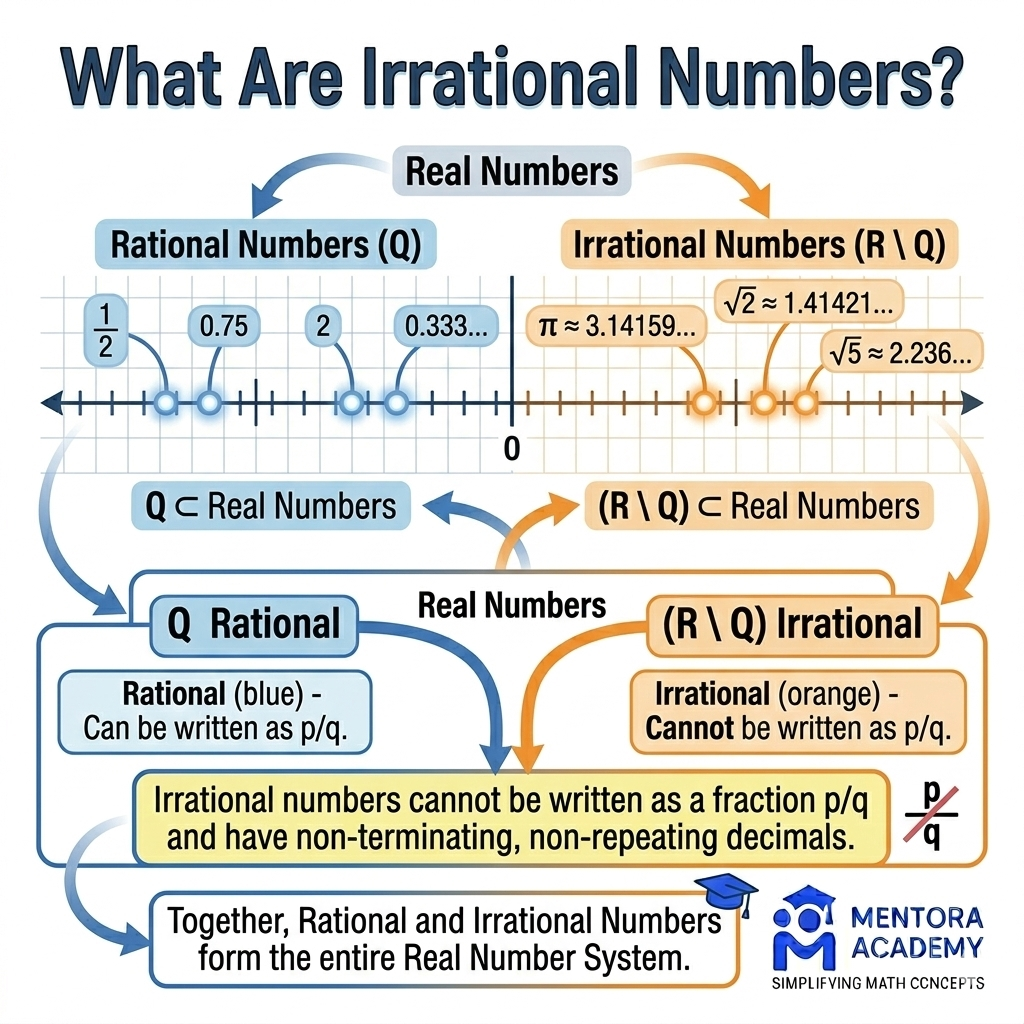
Irrational numbers are real numbers that cannot be expressed as a ratio of two integers (a/b where b ≠ 0) — their decimal expansions never end and never repeat, unlike fractions such as 1/2 or 3/4. Famous examples include π (pi), e (Euler’s number), √2, and the golden ratio φ. Ever wondered why these numbers can’t be written as simple fractions? In this comprehensive guide, you’ll discover all major types of irrational numbers, learn how to identify them, and master their properties.
What Is an Irrational Number?
Before exploring specific irrational numbers, let’s establish a clear definition:
Irrational Number Definition: A real number that cannot be expressed as a fraction of two integers (a/b where a and b are integers and b ≠ 0).
Key characteristics of irrational numbers:
- Non-terminating decimals – the digits go on forever
- Non-repeating decimals – no pattern ever repeats
- Cannot be written as a fraction – no ratio of whole numbers equals them
- Real numbers – they exist on the number line
- Infinite and uncountable – there are more irrational numbers than rational ones
What’s the Difference Between Rational and Irrational Numbers?
Understanding the difference between rational and irrational numbers is essential:
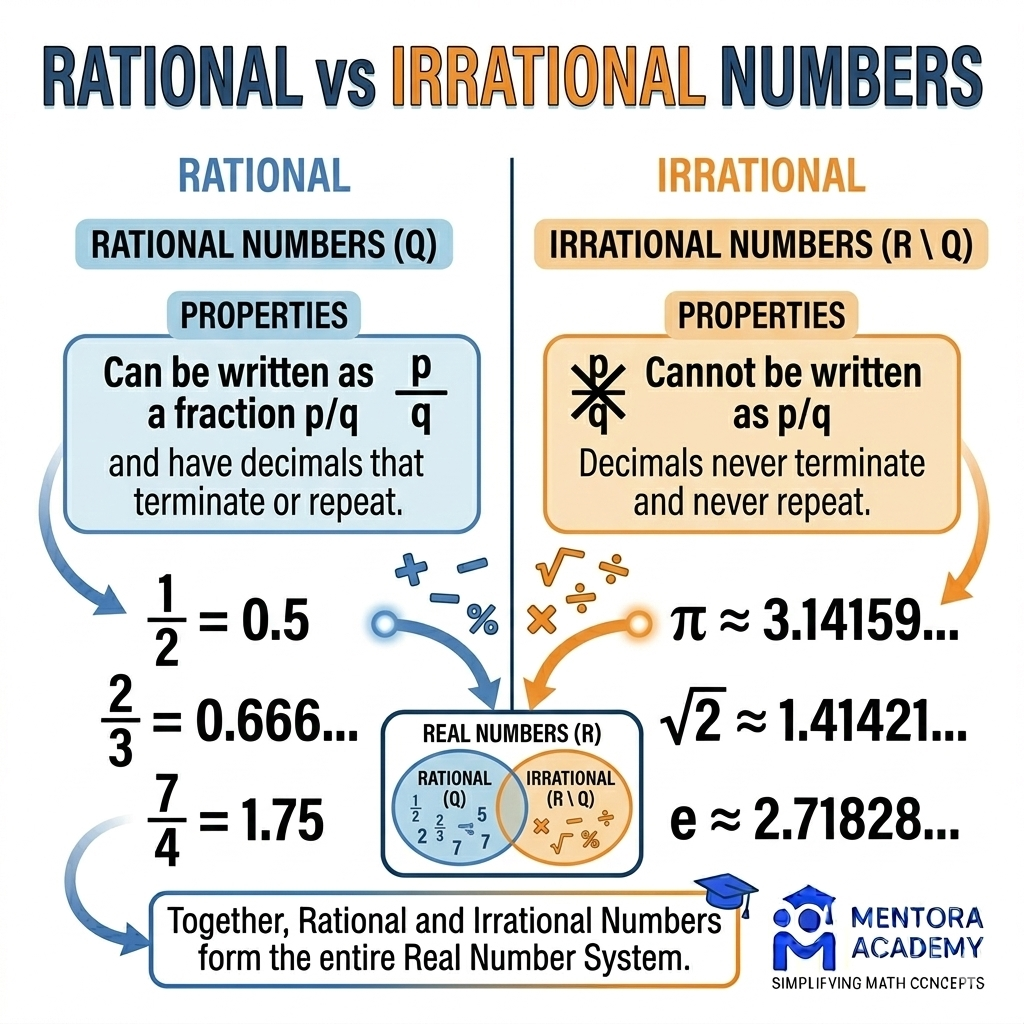
| Feature | Rational Numbers | Irrational Numbers |
|---|---|---|
| Fraction Form | CAN be written as a/b | CANNOT be written as a/b |
| Decimal Form | Terminates or repeats | Never terminates, never repeats |
| Examples | 1/2, 0.75, 3, -5, 0.333… | π, e, √2, √3, φ |
| Pattern | Predictable pattern | No repeating pattern |
| How Many? | Infinite, but countable | Infinite and uncountable |
What Are the Main Categories of Irrational Numbers?
Irrational numbers can be organized into several main categories:
1. Square Roots of Non-Perfect Squares
The most common type of irrational numbers are square roots of numbers that aren’t perfect squares.
Examples:
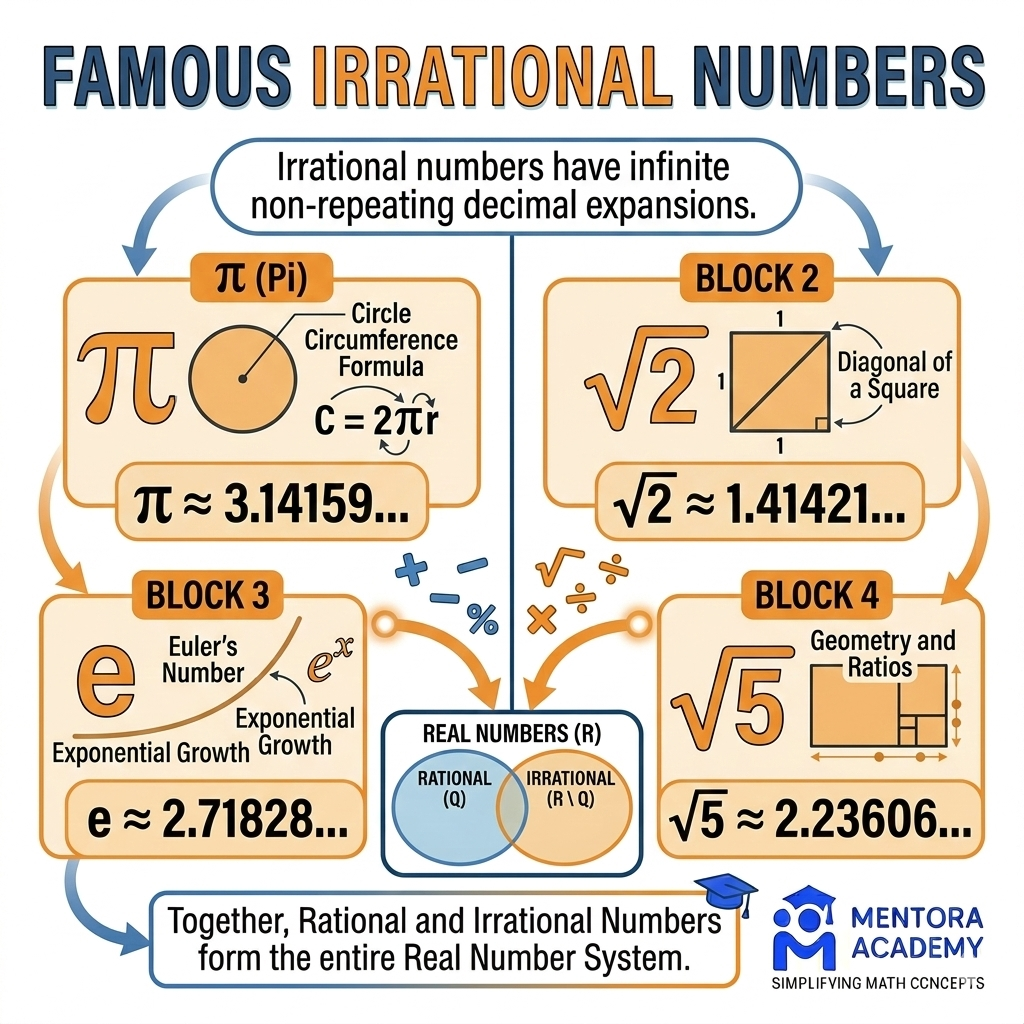
- √2 = 1.414213562373095… (proved irrational by ancient Greeks)
- √3 = 1.732050807568877…
- √5 = 2.236067977499789…
- √6 = 2.449489742783178…
- √7 = 2.645751311064590…
- √8 = 2.828427124746190… (also equals 2√2)
- √10 = 3.162277660168379…
Why these are irrational: If √n is irrational when n is not a perfect square (1, 4, 9, 16, 25, etc.). The decimal expansion never terminates or repeats.
⚠️ Important exception: √4 = 2, √9 = 3, √16 = 4 are RATIONAL because they equal whole numbers!
2. Mathematical Constants
Several famous mathematical constants are irrational:
π (Pi) ≈ 3.14159265358979323846…
Definition: The ratio of a circle’s circumference to its diameter
Value: 3.14159265358979323846264338327950288…
Why it’s famous: Appears in geometry, trigonometry, physics, and engineering
History: Known for over 4,000 years; proved irrational in 1761
Fun fact: Pi Day is celebrated on March 14 (3/14)
e (Euler’s Number) ≈ 2.71828182845904523536…
Definition: The base of natural logarithms
Value: 2.71828182845904523536028747135266249…
Why it’s important: Used in calculus, compound interest, exponential growth
Applications: Population growth, radioactive decay, finance
φ (Golden Ratio/Phi) ≈ 1.61803398874989484820…
Definition: (1 + √5)/2
Value: 1.61803398874989484820458683436563811…
Why it’s special: Appears in art, architecture, nature (Fibonacci sequence)
Examples: Nautilus shells, flower petals, human body proportions
3. Cube Roots and Higher Roots
Cube roots and higher roots of non-perfect powers are also irrational:
- ∛2 = 1.259921049894873… (cube root of 2)
- ∛3 = 1.442249570307408… (cube root of 3)
- ∛5 = 1.709975946676697… (cube root of 5)
- ⁴√2 = 1.189207115002721… (fourth root of 2)
⚠️ Important: Cube roots of perfect cubes (∛8 = 2, ∛27 = 3) are RATIONAL!
4. Combinations and Operations with Irrational Numbers
Combining irrational numbers can create new irrational numbers:
- π + e ≈ 5.859874… (sum of two irrational numbers)
- π × e ≈ 8.539734… (product of two irrational numbers)
- 2√2 ≈ 2.828427… (rational × irrational = irrational)
- π² ≈ 9.869604… (irrational squared)
- e^π ≈ 23.140692… (irrational to irrational power)
⚠️ Important exception: √2 × √2 = 2 (irrational × irrational CAN be rational!)
Need help mastering irrational numbers and number theory?
📞 Book a free evaluation: (514) 588-7682
Complete List: All Types of Irrational Numbers
Here’s a comprehensive categorization of irrational numbers:
📋 The Complete Classification
Category 1: Algebraic Irrational Numbers
- Square roots: √2, √3, √5, √6, √7, √8, √10, √11, √12…
- Cube roots: ∛2, ∛3, ∛4, ∛5, ∛6…
- Fourth roots: ⁴√2, ⁴√3, ⁴√5…
- Higher roots of non-perfect powers
- Golden ratio φ = (1 + √5)/2
- Silver ratio δ = 1 + √2
Category 2: Transcendental Numbers (NOT algebraic)
- π (pi) – circle constant
- e (Euler’s number) – natural logarithm base
- e^π (Gelfond’s constant)
- 2^√2 (Gelfond-Schneider constant)
- ln(2), ln(3), ln(5) – natural logarithms of integers
- sin(1), cos(1), tan(1) – trigonometric values (most angles)
Category 3: Combinations
- π + e, π – e, π × e, π / e
- √2 + √3, √2 – √3
- 2 + √5, 3 – √7
- Countless other combinations
How Do You Identify an Irrational Number?
Use these methods to determine if a number is irrational:
Method 1: Check the Decimal Expansion
Steps:
- Write out the decimal expansion (if possible)
- Look for termination: Does it end? → RATIONAL
- Look for repetition: Does a pattern repeat forever? → RATIONAL
- If neither terminates nor repeats → IRRATIONAL
Examples:
- 0.5 = 1/2 → Terminates → RATIONAL
- 0.333… = 1/3 → Repeats → RATIONAL
- 1.414213… (√2) → Never terminates, never repeats → IRRATIONAL
- 3.141592… (π) → Never terminates, never repeats → IRRATIONAL
Method 2: Try to Express as a Fraction
Steps:
- Attempt to write the number as a/b (where a and b are integers)
- If you can, it’s RATIONAL
- If you cannot (or it’s proven impossible), it’s IRRATIONAL
Examples:
- 0.75 = 3/4 → Can be written as fraction → RATIONAL
- √2 → Cannot be written as fraction → IRRATIONAL (proven by contradiction)
- π → Cannot be written as fraction → IRRATIONAL (proven in 1761)
Method 3: Special Rules for Square Roots
Rule: √n is irrational if n is NOT a perfect square
Perfect squares: 1, 4, 9, 16, 25, 36, 49, 64, 81, 100, 121, 144…
Examples:
- √16 = 4 → Perfect square → RATIONAL
- √17 → Not a perfect square → IRRATIONAL
- √100 = 10 → Perfect square → RATIONAL
- √101 → Not a perfect square → IRRATIONAL
Practice Problems
Basic Identification Problems
- Is √25 rational or irrational?
Solution: √25 = 5 (perfect square)
Answer: RATIONAL ✓ - Is √30 rational or irrational?
Solution: 30 is not a perfect square (between 25 and 36)
Answer: IRRATIONAL ✓ - Is 0.666… rational or irrational?
Solution: Decimal repeats (pattern = 6) = 2/3
Answer: RATIONAL ✓ - Is π/2 rational or irrational?
Solution: π is irrational; dividing by 2 (rational) keeps it irrational
Answer: IRRATIONAL ✓ - Is 0.101001000100001… rational or irrational?
Solution: Pattern exists but never repeats (gaps increase)
Answer: IRRATIONAL ✓
Intermediate Problems
- Is ∛8 rational or irrational?
Solution: ∛8 = 2 (8 = 2³ is a perfect cube)
Answer: RATIONAL ✓ - Is √2 + √2 rational or irrational?
Solution: √2 + √2 = 2√2 ≈ 2.828… (still irrational)
Answer: IRRATIONAL ✓ - Is √2 × √8 rational or irrational?
Solution: √2 × √8 = √16 = 4
Answer: RATIONAL ✓ - Is (1 + √5)/2 rational or irrational?
Solution: This is the golden ratio φ; √5 is irrational, so φ is irrational
Answer: IRRATIONAL ✓ - Is 3.14 rational or irrational?
Solution: 3.14 = 314/100 (terminates; this is NOT π, just an approximation)
Answer: RATIONAL ✓
Struggling with number theory and algebra concepts?
📞 Get expert help: (514) 588-7682
Advanced Problems
- If a and b are both irrational, is a + b always irrational?
Solution: NO! Example: √2 + (-√2) = 0 (rational)
Answer: Not always; can be rational ✓ - Is √(4/9) rational or irrational?
Solution: √(4/9) = √4/√9 = 2/3
Answer: RATIONAL ✓ - Is e + π rational or irrational?
Solution: Both e and π are irrational; their sum is believed irrational (unproven)
Answer: Likely IRRATIONAL (unproven) ✓ - Is log₁₀(2) rational or irrational?
Solution: log₁₀(2) ≈ 0.301029995… (proven irrational)
Answer: IRRATIONAL ✓ - Is sin(30°) rational or irrational?
Solution: sin(30°) = 1/2
Answer: RATIONAL ✓
Where Are Irrational Numbers Used in Real Life?
1. π (Pi) in Engineering and Design
Montreal Examples:
- Olympic Stadium dome: Calculating the curved roof area uses π
- Mount Royal lookout: Designing circular viewing platforms
- McGill’s Redpath Museum rotunda: Circular architectural elements
- Place Ville Marie: Circular plaza design calculations
2. √2 in Construction and Diagonals
Montreal Examples:
- Downtown building corners: Diagonal bracing uses √2 ratios
- NDG park paths: Diagonal walking paths across square fields
- Westmount homes: Diagonal measurements for room additions
- Lachine canal walkways: Contractors use √2 to cut diagonal paving corners for square courtyards
3. e in Finance and Growth
Applications:
- Bank interest: Continuous compounding uses e
- Population growth: Montreal’s demographic projections
- Radioactive decay: Medical applications at McGill Health Centre
4. φ (Golden Ratio) in Art and Nature
Montreal Examples:
- Montreal Museum of Fine Arts: Golden ratio in classical paintings
- Notre-Dame Basilica: Architectural proportions follow φ
- Biodome exhibits: Natural spiral patterns in shells
Common Mistakes Students Make
❌ Mistake #1: Thinking all decimals that don’t terminate are irrational
WRONG: « 0.333… goes on forever, so it’s irrational »
CORRECT: 0.333… = 1/3 is RATIONAL because it repeats. Only non-terminating AND non-repeating decimals are irrational.
❌ Mistake #2: Confusing irrational approximations with rational numbers
WRONG: « 3.14 is irrational because it’s close to π »
CORRECT: 3.14 = 314/100 is RATIONAL. It’s just an approximation of π, not π itself.
❌ Mistake #3: Assuming all square roots are irrational
WRONG: « Every square root is irrational »
CORRECT: √4 = 2, √9 = 3, √16 = 4 are all RATIONAL. Only square roots of non-perfect squares are irrational.
❌ Mistake #4: Believing irrational × irrational is always irrational
WRONG: « The product of two irrational numbers is always irrational »
CORRECT: √2 × √2 = 2 (rational). The product CAN be rational!
❌ Mistake #5: Rounding and claiming exactness
WRONG: « π = 3.14 » or « √2 = 1.41 »
CORRECT: π ≈ 3.14 and √2 ≈ 1.41. Use the ≈ symbol to show approximation, never exact equality.
Why Do Irrational Numbers Matter in Math?
Understanding irrational numbers is essential for:
- Geometry: Circle calculations, diagonal measurements, volume formulas
- Algebra: Solving equations, simplifying radicals, working with exponents
- Calculus: Limits, derivatives, integrals involving e and π
- Quebec curriculum: Core Secondary 3-5 number theory requirement
- Real-world problem solving: Engineering, physics, computer science
- University preparation: Foundation for advanced mathematics at McGill, Concordia, UdeM
Frequently Asked Questions (FAQ)
❓ What are all the irrational numbers?
Answer: There are infinitely many irrational numbers. Major categories include: square roots of non-perfect squares (√2, √3, √5, √6, √7, √8, √10, etc.), mathematical constants (π, e, φ), cube roots of non-perfect cubes (∛2, ∛3, ∛5, etc.), and combinations of irrational numbers. In fact, there are more irrational numbers than rational numbers on the number line.
❓ How do you know if a number is irrational?
Answer: A number is irrational if: 1) Its decimal expansion never terminates and never repeats, 2) It cannot be expressed as a fraction a/b where a and b are integers, or 3) For square roots, if √n where n is not a perfect square. Examples: π, e, √2, √3 are irrational. Examples of rational: 0.5, 0.333…, √4 = 2.
❓ Is π (pi) an irrational number?
Answer: Yes, π is irrational. This was proven by Johann Lambert in 1761. π = 3.14159265358979… never terminates and never repeats. It cannot be expressed as a fraction of two integers, making it definitively irrational. Common approximations like 22/7 or 3.14 are rational numbers close to π, but not π itself.
❓ What’s the difference between rational and irrational numbers?
Answer: Rational numbers can be expressed as a fraction a/b (where b ≠ 0) and have decimal expansions that either terminate (0.5, 0.75) or repeat forever (0.333…, 0.142857142857…). Irrational numbers cannot be expressed as fractions and have decimal expansions that never terminate and never repeat (π, e, √2, √3).
❓ Are all square roots irrational?
Answer: No, not all square roots are irrational. Square roots of perfect squares are rational: √4 = 2, √9 = 3, √16 = 4, √25 = 5, etc. However, square roots of non-perfect squares are irrational: √2, √3, √5, √6, √7, √8, √10, etc.
❓ Is 0.333… (repeating) rational or irrational?
Answer: 0.333… (repeating) is RATIONAL, not irrational. It equals 1/3. Even though the decimal goes on forever, it has a repeating pattern (the digit 3 repeats). Only decimals that never terminate AND never repeat are irrational. The key distinction: 0.333… repeats, so it’s rational.
❓ What is the golden ratio and is it irrational?
Answer: The golden ratio φ (phi) = (1 + √5)/2 ≈ 1.618033988… is irrational. It appears frequently in nature, art, and architecture. Since √5 is irrational, and you cannot make it rational by adding 1 and dividing by 2, the golden ratio remains irrational. It’s connected to the Fibonacci sequence and appears in spiral patterns in nature.
❓ Can the product of two irrational numbers be rational?
Answer: Yes! The product of two irrational numbers can be rational. Classic example: √2 × √2 = 2 (rational). Another example: √3 × √3 = 3 (rational). However, the product can also be irrational, such as √2 × √3 = √6 (irrational). It depends on the specific numbers involved.
❓ Why is √2 irrational?
Answer: √2 is irrational, which was proven by ancient Greek mathematicians using proof by contradiction. If √2 were rational (√2 = a/b in lowest terms), then 2 = a²/b², so 2b² = a². This means a² is even, so a is even. Let a = 2k, then 2b² = 4k², so b² = 2k², making b even too. But if both a and b are even, the fraction wasn’t in lowest terms, which is a contradiction. Therefore, √2 cannot be rational.
❓ How many irrational numbers are there?
Answer: There are infinitely many irrational numbers. In fact, there are MORE irrational numbers than rational numbers (irrational numbers are uncountably infinite, while rational numbers are countably infinite). Between any two numbers on the number line, there are infinitely many irrational numbers. Most real numbers are irrational.
Summary
Key Takeaways:
- Definition: Irrational numbers cannot be written as fractions a/b
- Decimal form: Non-terminating, non-repeating expansions
- Main types: Square roots of non-perfect squares, π, e, φ, cube roots, combinations
- Identification: Check if decimal terminates or repeats; if neither, it’s irrational
- Perfect square test: √n is irrational when n is not a perfect square
- Famous examples: π ≈ 3.14159…, e ≈ 2.71828…, √2 ≈ 1.41421…, φ ≈ 1.61803…
- Key fact: There are infinitely more irrational than rational numbers
🎯 Struggling with Irrational Numbers? We Can Help!
Get expert math tutoring today
Join 2,500+ Montreal students who improved their grades
✓ Free evaluation session
✓ Certified expert tutors
✓ Proven results in weeks
Available 7 days/week • Same-day appointments • Satisfaction guaranteed
Ready to Master This Topic?
Our expert tutors in Montreal can help you succeed.
Book Free Math Evaluation